
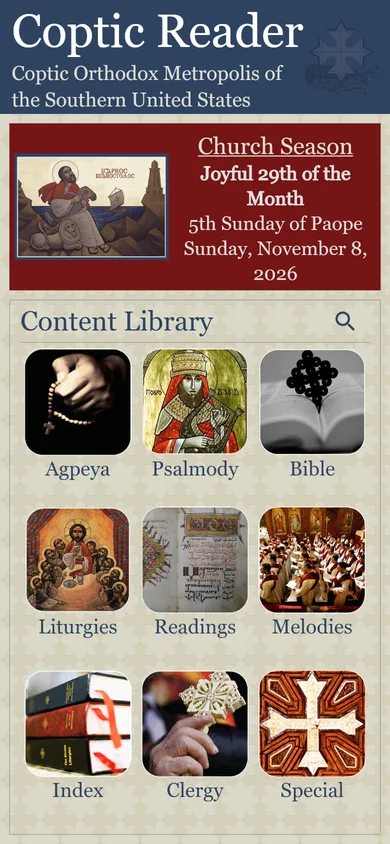
About the Agpeya
For someone new to the Church, the Agpeya can seem mysterious at first. One may hear it said, “We prayed the Third and Sixth Hours before the Liturgy,” or come upon a small prayer book filled with Psalms, Gospel readings, litanies, and the repeated cry, “Lord, have mercy.” At first glance it can appear to be only a long sequence of prayers. Yet the Agpeya is not an arbitrary collection. It is a daily rhythm of prayer that teaches the believer to offer the whole day to God.
Many suppose that prayer must always be spontaneous. Personal prayer in one’s own words is indeed precious, but the Church also gives us received prayers, not because God requires formal language but because we ourselves need formation.
The Agpeya teaches us what to pray for and how to pray. It trains the heart in thanksgiving, repentance, humility, praise, intercession, confession, and the contemplation of God. It also keeps the words of Scripture upon our lips, for much of the Agpeya is drawn directly from the Psalms and the Gospels.
The newcomer may think of the Agpeya as a school of prayer. It does not replace personal prayer; it forms and strengthens it. In time, its words teach the believer to speak to God with honesty, reverence, and hope. It is one of the most practical ways the faithful learn to pray with the whole Church, beyond the Sunday gathering.
Why we pray at fixed hours
The practice of praying at appointed times is rooted in Scripture. Besides the Psalmist’s “Seven times a day I praise You,” the New Testament shows the early Christians praying at set hours: the Book of Acts speaks of the Third, the Sixth, and the Ninth Hours in connection with the great moments of apostolic life and prayer.
The point is not that God hears prayer only at certain times. Rather, the hours teach us to return to Him throughout the day. Work, study, family duties, and countless distractions can easily lay claim to every waking moment. The Agpeya interrupts that pattern and reminds us that this hour, too, belongs to Christ.
A brief history and liturgical background
The Agpeya belongs to the ancient tradition of the canonical hours. Coptic sources describe it as a Book of Hours, with seven prayers arranged through the day, each bearing a theme drawn from the life and saving work of our Lord Jesus Christ.
Its history is best understood in three layers. The first is its biblical root: the habit of praising God repeatedly through the day and praying at appointed hours, as the Psalmist and the apostles did. The second is its liturgical shape: the Church orders the hours around the Resurrection of Christ, the descent of the Holy Spirit, the Crucifixion, His life-giving death, His burial, and His coming again. The third is its place in daily formation: the same prayers are used in personal prayer, in the home, in the parish, and in preparation for the Divine Liturgy.
So when a Coptic Christian prays the Agpeya today, he is not devising a private routine. He enters a shared tradition of the whole Church, shaped by Scripture and centered upon Christ.
Why Psalm 50 opens every hour
Once its structure is understood, the Agpeya becomes far easier to follow. The exact text differs from hour to hour, and some editions arrange the smaller transitional prayers a little differently, but the order itself is a teaching. The Agpeya does not begin with self-expression alone. It places us first before God, and then moves through thanksgiving, repentance, Scripture, Gospel, petition, mercy, and conclusion.
Psalm 50 is the doorway of repentance in the Agpeya. It begins, “Have mercy upon me, O God.” The Church sets this Psalm at the head of every hour because prayer begins in humility.
This is not to say that the believer comes before God in despair. Repentance in the Orthodox life is not self-hatred; it is the honest return of the heart to God. Each hour opens by asking Him to cleanse, to renew, and to restore us.
Why the Psalms are central
The Psalms are the backbone of the Agpeya, and this is one reason the book is so powerful a teacher for the newcomer. When we pray it, we are not only speaking our own words; we are praying Scripture.
The Psalms hold within them joy and sorrow, fear and hope, repentance and thanksgiving, struggle, trust, and praise. At times a Psalm says exactly what we feel; at other times it teaches the heart what it needs to learn. Through repetition, the Psalms slowly reshape the way we speak to God.
Why “Lord, Have Mercy” is said forty-one times
Near the end of each hour, with its praises and, where appointed, the Creed, the Agpeya repeats the prayer, “Lord, have mercy,” in Greek, Kyrie eleison. The Coptic liturgical guides commonly explain the number forty-one as a remembrance of the sufferings of Christ: the thirty-nine lashes, the crown of thorns, and the wound of the spear in His side.
The repetition is not empty. It is a simple way to place the whole heart beneath the mercy of Christ. When we do not know what to say, the Church gives us one of the deepest prayers of all: Lord, have mercy.
Must all seven hours be prayed?
The seven hours together form the complete daily cycle of prayer. Monastics, clergy, and some of the laity may pray much of this cycle, but the newcomer should not treat the Agpeya as an all-or-nothing burden. The faithful usually grow into that rhythm gradually, and with pastoral guidance; in ordinary life, many pray the morning hour upon waking, the evening hour near sunset, and Compline before sleep.
The Agpeya is not a checklist of spiritual achievement; it is a path of return to God.
It is also natural not to understand everything at first. The Agpeya is learned by being prayed. In time the repeated phrases grow familiar, the Psalms begin to shape the heart, and the rhythm of the hours becomes far less daunting.
Why the Agpeya is prayed before the Liturgy
In Coptic practice the canonical hours are prayed as preparation for the Eucharist. Besides the Third, Sixth, and Ninth Hours, the service guides note that in seasons such as Great Lent and the Fast of Jonah still further hours may be prayed.
This teaches the newcomer something important: the Divine Liturgy is approached with preparation. The Agpeya gathers the Church into repentance, Scripture, the remembrance of the Cross, and the mercy of God before the Eucharistic offering is made.
Praying the Agpeya in English
The Agpeya may be prayed in Coptic, in Arabic, in English, or in any language one understands. For the beginner, what matters most is attention, reverence, and repentance. Learning a few of the repeated Coptic or Arabic phrases can be a beautiful thing, especially in the life of the parish, but prayer is no less real for being offered in English.
A companion on the Coptic journey
The Agpeya is among the great practical gifts of the Church. It teaches the newcomer that prayer is not confined to Sunday, to the church services, or to moments of crisis. The whole day may become prayer.
In the morning we rise with Christ. At noon we stand beneath His Cross. In the evening we examine the day. Before sleep we entrust ourselves to His mercy. At midnight we remember that He is coming again.
For the newcomer the Agpeya may begin as a book. With time it becomes a rhythm; then a teacher; and at last a companion. Hour by hour, it trains the heart to return to God. This is the heart of the Agpeya: not to fill the day with words, but to fill the day with the presence of God.
Sources consulted
This guide was informed by diocesan, parish, and liturgical sources.
- Coptic Orthodox Diocese of the Southern United States, RIT 101: Liturgy, Agpeya and Praises.
- CopticChurch.net, The Agpeya: The Prayers of the Hours, and The Prayer of the First Hour.
- St. Mary Coptic Orthodox Church, Seattle, The Agpeya: Coptic Orthodox Prayer Book.
- Coptic Orthodox Diocese of the Southern United States Sunday School Curriculum, Grade 5, The Agpeya.
- CopticChurch.net, Liturgy of St. Basil Reference Book.


