
الأنبياء الصغار · الجزء 7
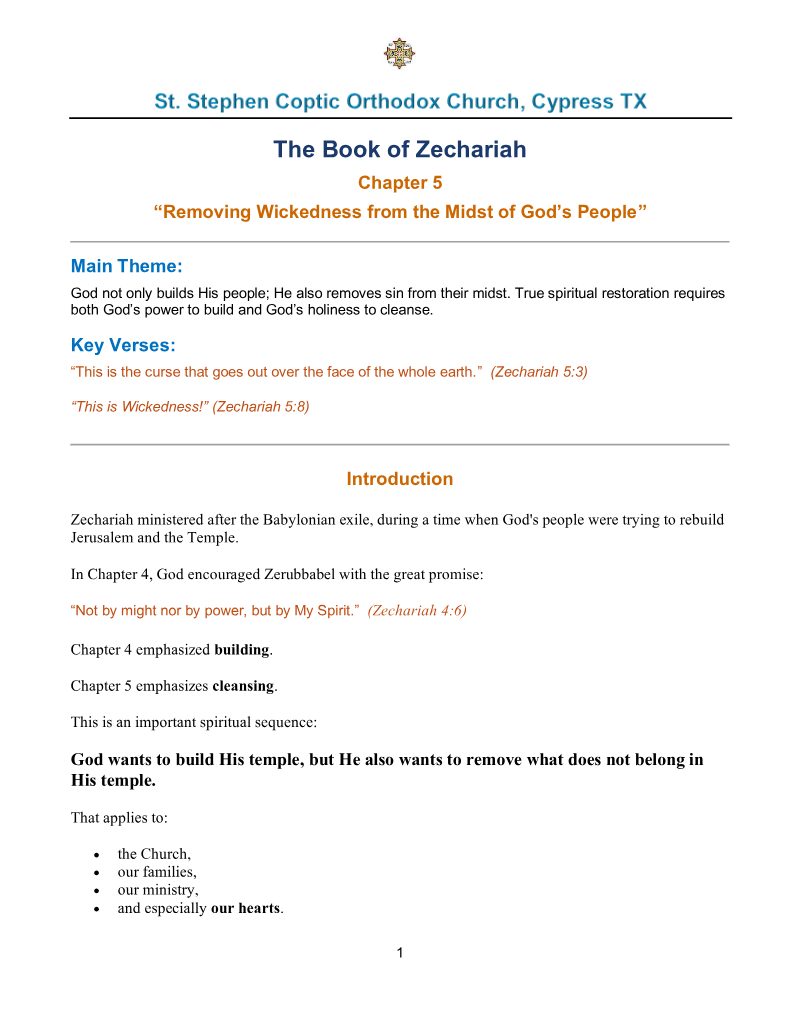
Zechariah 5
Removing Wickedness from the Midst of God’s People
- التاريخ
- السلسلة
- الأنبياء الصغار
- الفكرة الرئيسية
- God not only builds His people; He also removes sin from their midst. True spiritual restoration requires both God’s power to build and God’s holiness to cleanse.
الآية الرئيسية
“This is the curse that goes out over the face of the whole earth.”
الآية الرئيسية
“This is Wickedness!”
في هذه الصفحة
المخطط
Introduction
Zechariah ministered after the Babylonian exile, during a time when God's people were trying to rebuild Jerusalem and the Temple.
In Chapter 4, God encouraged Zerubbabel with the great promise:
“Not by might nor by power, but by My Spirit.”
Chapter 4 emphasized building.
Chapter 5 emphasizes cleansing.
This is an important spiritual sequence:
God wants to build His temple, but He also wants to remove what does not belong in His temple.
That applies to:
- the Church,
- our families,
- our ministry,
- and especially our hearts.
Zechariah 5 contains two closely related visions: the flying scroll and the woman in the ephah. Together they show God's judgment on sin and His determination to remove wickedness from His people. Although they appear as two scenes, they are closely connected: the first announces God's judgment against sin, and the second depicts wickedness being removed and taken away.
Part 1: The Flying Scroll, Zechariah 5:1-4
Zechariah says: “Then I turned and raised my eyes, and saw there a flying scroll.” (Zechariah 5:1)
The scroll is enormous: “Its length is twenty cubits and its width ten cubits.” (Zechariah 5:2)
The scroll’s size is significant (approximately 30 feet by 15 feet).
Why is the scroll flying?
Because God's Word is going out. It is not sitting quietly on a shelf. It is moving across the land, bringing God's judgment.
What is written on the scroll?
Verse 3 identifies two sins:
- Stealing; “Every thief shall be expelled...”
- False swearing; “Every perjurer shall be expelled...”
These represent two dimensions of sin.
Stealing violates our relationship with people.
False swearing violates our relationship with God.
The Ten Commandments address both:
- “You shall not steal.”
- “You shall not bear false witness.”
God cares about our actions and our words.
Part 2: Sin Cannot Be Hidden, Zechariah 5:4
God says: “It shall enter the house of the thief and the house of the one who swears falsely by My name.”
Notice something: The curse enters the house.
Sin is not merely an individual matter. What happens in our hearts eventually affects:
- our homes,
- our marriages,
- our children,
- our friendships,
- our ministry,
- our church.
A hidden sin can eventually become a public destruction.
The verse says that the curse will: “remain in the midst of his house, And consume it, with its timber and stones.”
Application
We sometimes say: “It's my private life.”
But sin rarely remains private.
What we allow into our hearts eventually enters our homes.
The Deeper Meaning: God's Word Exposes Sin
The scroll is a powerful picture of the Word of God.
St. Paul says in Hebrews: “For the word of God is living and powerful...” (Hebrews 4:12)
God's Word does not merely comfort us. It also confronts us.
Sometimes we come to Scripture asking: “Lord, encourage me.”
And God answers: “Yes, but first let Me show you what needs to change.”
The Bible is: a comfort, a guide, a light, a mirror, and a sword.
James 1 compares God's Word to a mirror. We don't look into a mirror simply to admire ourselves.
We look so we can see what needs to be corrected.
A Very Important Question
A mature Christian doesn't only ask: “What does the Bible say?”
He also asks: “What does God want to change in me because of what the Bible says?”
Part 3: The Woman in the Ephah, Zechariah 5:5-6
Now the vision changes.
The angel says: “This is an ephah that goes forth.” (Zechariah 5:6)
An ephah was a large measuring container (about 6 Gallons)
Inside it is a woman.
And the angel gives the interpretation: “This is Wickedness!” (Zechariah 5:8)
This is remarkable.
In the first vision, God identifies specific sins: stealing and false swearing.
In the second, He reveals the larger problem: Wickedness itself.
God is not interested merely in treating symptoms. He wants to deal with the root of sin.
Why Is Wickedness Inside a Measuring Container?
God is measuring wickedness because Sin has limits.
God allows people to exercise their freedom, but sin does not continue forever without judgment. God is patient, but God's patience should never be mistaken for God's approval.
There comes a point when God says: Enough.
Genesis 15:16 gives a similar principle when God speaks about the “iniquity of the Amorites” becoming complete.
Part 4: The Lead Cover, Zechariah 5:7-8
The angel places the woman inside the ephah and puts a heavy lead cover over it. The image is striking.
Wickedness is: contained, restrained, and removed.
This is a picture of God controlling and ultimately removing wickedness.
The chapter is therefore not primarily a frightening chapter. It is actually a chapter of hope.
Because God is saying: “Wickedness will not have the final word.”
Part 5: The Two Women with Wings, Zechariah 5:9-11
Zechariah sees: “there came out two women, coming with the wind in their wings...” (Zechariah 5:9)
They lift the ephah: “between earth and heaven.”
Zechariah asks: “Where are they carrying the basket?”
The angel answers: “To build it a house in the land of Shinar...” (Zechariah 5:11)
What Is Shinar?
Shinar is associated with ancient Babylon.
Think back to Genesis 11. Humanity gathered in Shinar and said: “Let us build ourselves a city...”
and attempted to build the Tower of Babel.
Babylon becomes throughout Scripture a symbol of:
- rebellion,
- human pride,
- idolatry,
- opposition to God.
Wickedness is being removed from God's people and taken back to its proper place.
God is establishing a distinction: Jerusalem belongs to God. Wickedness belongs outside God's holy dwelling.
A Critical Spiritual Principle
This chapter teaches something very important:
God does not want us merely to add holiness; He wants us to remove wickedness.
Sometimes our Christian life looks like this: “I need to pray more.” ……. Good.
“I need to read the Bible more.” ……. Good.
“I need to serve more.” ……. Good.
But God may be saying: “There is also something you need to remove.”
Perhaps:
- bitterness,
- dishonesty,
- jealousy,
- pride,
- unforgiveness,
- impurity,
- gossip,
- greed,
- hypocrisy,
- an unhealthy relationship,
- an addiction to something,
- a secret sin.
Christian growth is not only Adding good things.
It is also: Removing things that do not belong.
Christ in Chapter 5 (Zechariah is ultimately a Messianic book)
1. Christ came to deal with the problem of sin
John the Baptist introduced Jesus: “Behold! The Lamb of God who takes away the sin of the world!” (John 1:29)
Zechariah 5 shows God's determination to remove wickedness.
The Gospel shows us how God ultimately deals with sin: Through Jesus Christ.
2. Christ cleanses His temple
In the Gospels, Jesus enters the Temple and drives out those who were corrupting it. He says: “My house shall be called a house of prayer.” (Matthew 21:13)
The principle of Zechariah 5 is fulfilled: God's house must not become a dwelling place for wickedness.
And Paul tells us: “You are the temple of God and that the Spirit of God dwells in you.” (1 Corin. 3:16)
Therefore, the question becomes personal: What needs to be driven out of the temple of my heart?
Christ Gives Us Victory Over Sin
Christ did not come merely to forgive us while leaving us enslaved to sin. He came to free us from the dominion of sin.
St. Paul says: “Sin shall not have dominion over you.” (Romans 6:14)
This is the hope behind Zechariah 5.
God doesn't merely say: “I see your wickedness.” or “I judge your wickedness.”
He says: “I will deal with it.”
Through Christ:
- sin can be forgiven,
- hearts can be cleansed,
- habits can be broken,
- relationships can be restored,
- lives can be transformed.
Practical Applications
Application 1: Let God's Word examine you
Don't only read Scripture. Let Scripture read you.
Ask: “Lord, what are You showing me about myself?”
Application 2: Identify the “thief”
The chapter specifically mentions stealing. But theft can take many forms.
We can steal:
- money,
- time,
- someone's reputation,
- someone's peace,
- credit for another person's work,
- opportunities,
- trust.
Ask: “Is there anything I am taking that God has not given me?”
Application 3: Examine your words
The second sin is false swearing.
Lord Jesus says: “Let your ‘Yes’ be ‘Yes,’ and your ‘No,’ ‘No.’” (Matthew 5:37)
Christian character includes truthfulness. Our words should be trustworthy.
Can people believe me when I speak?
Application 4: Don't build a house for sin
The vision ends with wickedness being given a place in Shinar.
Ask yourself: “Am I giving sin a permanent place in my life?”
Sometimes we don't commit a sin accidentally. We make room for it.
We create:
- routines,
- environments,
- relationships,
- habits,
- private spaces where temptation repeatedly finds us. Wisdom says: Don't negotiate with sin. Remove the opportunity.
Application 5: Don't only ask “What should I add?”
For spiritual growth, ask two questions:
What do I need to add?
Prayer.
Bible reading.
Fellowship.
Service.
Worship.
What do I need to remove?
Sin.
Bitterness.
Pride.
Dishonesty.
Unforgiveness.
Compromise.
Spiritual growth requires both.
Closing Prayer
“Lord Jesus Christ, You are the One who cleanses Your people and makes us vessels for Your glory. Search our hearts through Your Word. Reveal every sin, every compromise, every hidden attitude, and everything that does not belong in Your temple. Give us courage not only to add what is good but to remove what is sinful. Cleanse our hearts, sanctify our lives, and fill us with Your Holy Spirit. May our homes, our service, and our church be places where Your holiness dwells. Help us to live in the freedom and victory You have given us through Your Cross and Resurrection. Amen.”
9 صفحات في ملف الدراسة
الأنبياء الصغار
المزيد من هذه السلسلة
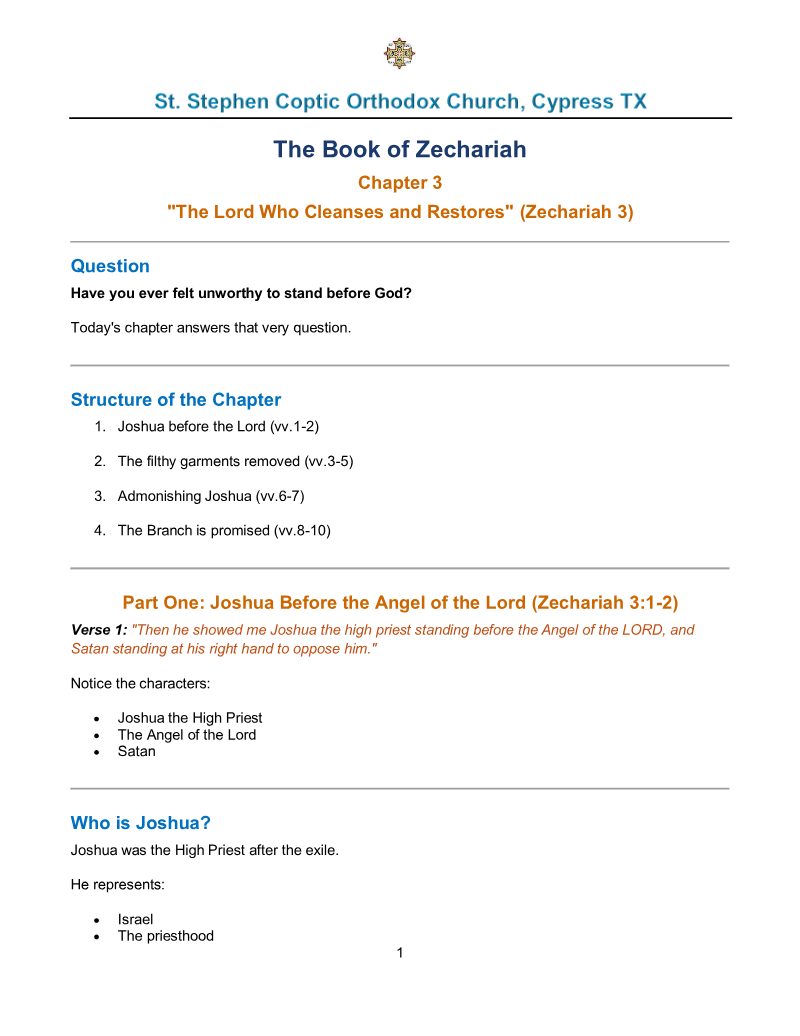
Zechariah 3
"The Lord Who Cleanses and Restores" (Zechariah 3)
بالإنجليزية فقطالجزء 6 · السابق
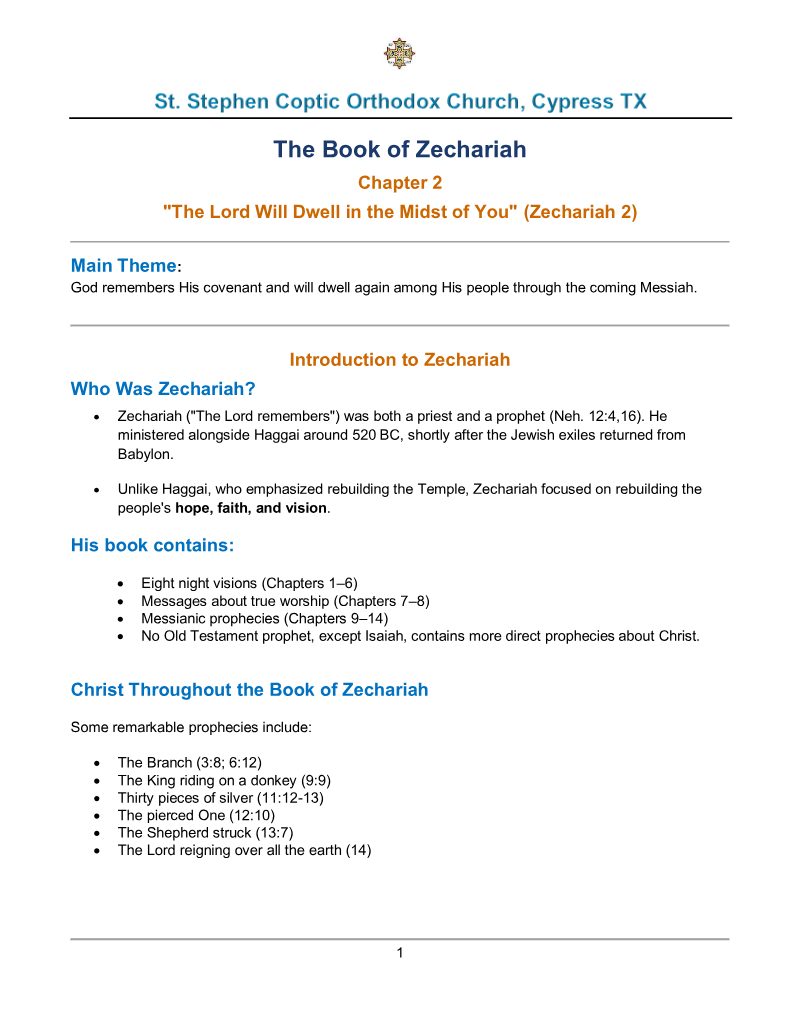
Zechariah 2
"The Lord Will Dwell in the Midst of You" (Zechariah 2)
بالإنجليزية فقطالجزء 5
سلسلة الأنبياء الصغار
13 دراسة حتى الآن، الأحدث أولًا. يظهر الجزء التالي هنا بعد دراسة الكتاب المقدس الإنجليزية القادمة.
عرض السلسلة كاملة