
الأنبياء الصغار · الجزء 12
Zechariah 10
The Lord Is Our Shepherd: Restoration, Strength, and the True Shepherd
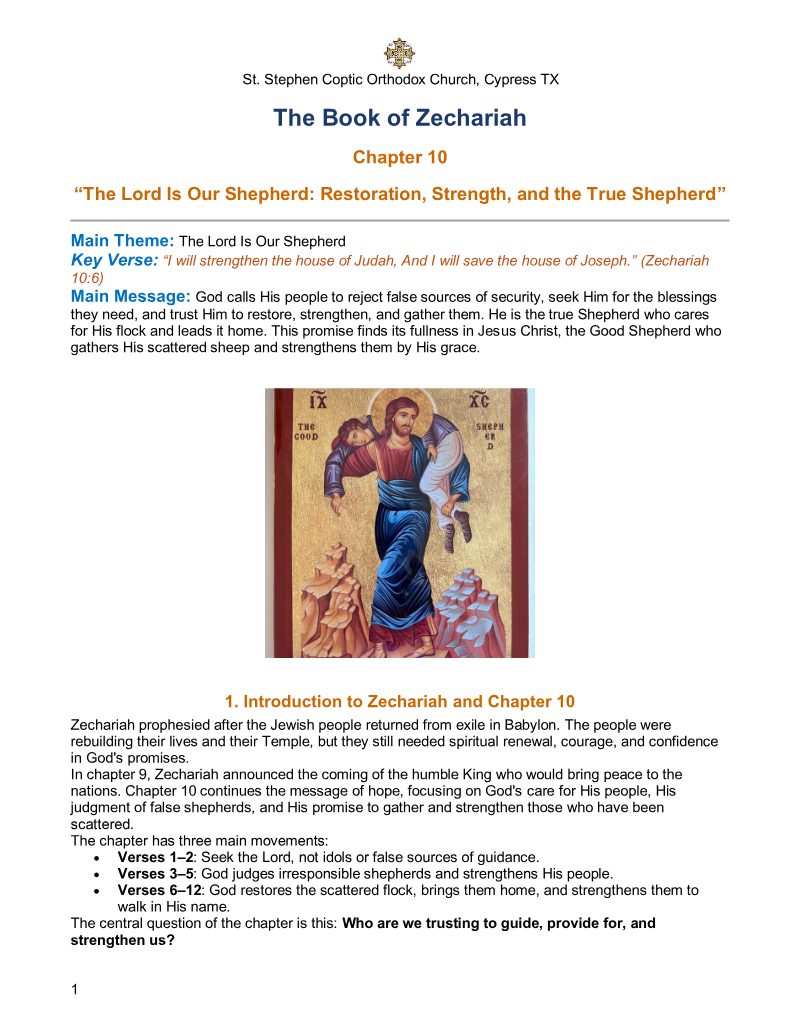
God calls His people to reject false sources of security, seek Him for the blessings they need, and trust Him to restore, strengthen, and gather them. He is the true Shepherd who cares for His flock and leads it home. This promise finds its fullness in Jesus Christ, the Good Shepherd who gathers His scattered sheep and strengthens them by His grace.
- التاريخ
- السلسلة
- الأنبياء الصغار
- الفكرة الرئيسية
- The Lord Is Our Shepherd
الآية الرئيسية
“I will strengthen the house of Judah, And I will save the house of Joseph.”
في هذه الصفحة
المخطط
1. Introduction to Zechariah and Chapter 10
Zechariah prophesied after the Jewish people returned from exile in Babylon. The people were rebuilding their lives and their Temple, but they still needed spiritual renewal, courage, and confidence in God's promises.
In chapter 9, Zechariah announced the coming of the humble King who would bring peace to the nations. Chapter 10 continues the message of hope, focusing on God's care for His people, His judgment of false shepherds, and His promise to gather and strengthen those who have been scattered.
The chapter has three main movements:
- Verses 1–2: Seek the Lord, not idols or false sources of guidance.
- Verses 3–5: God judges irresponsible shepherds and strengthens His people.
- Verses 6–12: God restores the scattered flock, brings them home, and strengthens them to walk in His name.
The central question of the chapter is this: Who are we trusting to guide, provide for, and strengthen us?
2. Ask the Lord for Rain: Seek the True Source of Blessing (Verses 1–2)
'1Ask the Lord for rain in the time of the latter rain. The Lord will make flashing clouds; He will give them showers of rain, Grass in the field for everyone. 2For the idols speak delusion; The diviners envision lies, and tell false dreams; They comfort in vain. Therefore the people wend their way like sheep; they are in trouble because there is no shepherd.'
A. “Ask the LORD for rain”
Rain was essential for agriculture and survival in the land of Israel. By telling the people to ask the Lord for rain, Zechariah reminds them that God is the ultimate source of provision.
The problem was not simply that the people needed rain. They also needed to return to the Lord rather than seeking guidance from idols, diviners, and deceptive sources.
Verse 2 explains that idols speak emptiness, diviners see false visions, and misleading dreams offer false comfort.
The result is that the people wander like sheep without a shepherd.
The spiritual principle is clear: When we seek guidance apart from God, we risk being led by false promises and our own desires.
B. What are our modern idols?
An idol is not necessarily a statue. Anything that takes God's rightful place in our hearts can become an idol.
Examples include:
- Money, when we trust it more than God's providence.
- Human approval, when we compromise our convictions to please others.
- Career success, when it becomes more important than our relationship with Christ.
- Entertainment and distractions, when they leave no room for prayer.
- Our own opinions, when we refuse to let Scripture correct us.
These things are not all evil in themselves. The danger arises when we depend on them as though they can give us the security, identity, or peace that only God can provide.
C. Christ, the source of living water
Read John 7:37–39.
Jesus invites the thirsty to come to Him. In the context of Zechariah 10, we can see an important spiritual connection: the people need to seek God for rain, while Christ offers the living water of the Holy Spirit.
God does not merely provide things for His people; He invites them into communion with Himself.
Patristic reflection
St. Cyril of Alexandria, in his commentary on the Gospel of St. John, emphasizes Christ as the giver of the Holy Spirit and the source of spiritual life. This helps us see that our deepest thirst is answered not merely by external blessings, but by the Spirit of God working within us.
Practical applications
- Before making a decision: Pray, examine Scripture, and seek wise spiritual counsel rather than following every popular opinion.
- When anxious about provision: Work responsibly, but remember that your ultimate trust belongs to God.
- For parents: Teach children to bring their questions and worries to God rather than relying only on social media or peer opinions.
- For servants: Do not replace prayer and spiritual discernment with programs, activities, or human strategies.
تأمّل
What source of security or guidance am I tempted to trust more than God?
3. God Judges the False Shepherds and Strengthens His People (Verses 3–5)
“3My anger is kindled against the shepherds, and I will punish the goatherds. For the Lord of hosts will visit His flock, The house of Judah, and will make them as His royal horse in the battle. 4From him comes the cornerstone, from him the tent peg, from him the battle bow, from him every ruler together. 5They shall be like mighty men, who tread down their enemies in the mire of the streets in the battle.
They shall fight because the Lord is with them, And the riders on horses shall be put to shame.”
A. “My anger is kindled against the shepherds” (Verse 3)
The shepherds represent leaders who were responsible for guiding and protecting the people. Instead of caring for the flock faithfully, they had failed in their responsibility.
In Scripture, shepherds can refer to political rulers, spiritual leaders, and those entrusted with the care of God's people.
God's anger against the shepherds reveals His concern for those who are vulnerable. Leadership is not simply a position of honor; it is a sacred responsibility.
In Ezekiel 34: 1-16, God rebukes shepherds who feed themselves rather than the flock. They fail to strengthen the weak, heal the sick, or seek the lost. God then promises to search for His sheep and care for them Himself.
This prepares us to understand the words of Jesus in John 10: He is the Good Shepherd who gives His life for the sheep.
B. A warning for everyone who serves
This passage is especially important for priests, Sunday school servants, ministry leaders, parents, and anyone entrusted with the spiritual care of others.
We should ask ourselves:
- Do I serve people, or do I expect people to serve me?
- Do I notice those who are struggling, or only those who are active and successful?
- Do I encourage the weak, or become impatient with them?
- Do I guide people toward Christ, or make them dependent on my own personality?
A shepherd's success is not measured only by the number of people gathered, but by whether those people are being led closer to Christ.
C. “The cornerstone, tent peg, and battle bow” (Verse 4)
The verse presents three images of strength and stability:
- The cornerstone: the foundation that holds a structure together.
- The tent peg: an image of stability and firmness.
- The battle bow: a symbol of strength and victory.
The verse refers to rulers coming from among God's people.
Also it points to the Messiah, while recognizing its immediate setting in God's promise to strengthen Judah at time of Zechariah.
Christ is the true foundation of His people.
In Ephesians 2:19–22, Christ is the cornerstone, and the people of God are being built together into a dwelling place for God in the Spirit.
D. Christ, the Good Shepherd
In John 10:11–15, Jesus distinguishes Himself from the hired servants who abandon the sheep when danger comes. Christ willingly lays down His life for the flock.
Patristic reflection
St. John Chrysostom, in his homilies on the Gospel of John, draws attention to Christ's voluntary sacrifice and the love revealed in His death. The Good Shepherd does not care for the sheep merely out of duty; He gives Himself for them.
Practical applications
- For leaders: Examine your motives regularly. Are you seeking Christ's glory or personal recognition?
- For parents: Do not focus only on correcting your children. Also listen, encourage, protect, and pray with them.
- For church servants: Notice the quiet, absent, discouraged, and overlooked members of the congregation.
- For every Christian: Do not place your ultimate trust in human leaders. Respect and learn from faithful leaders, but follow Christ as the supreme Shepherd.
تأمّل
Who is one person God has entrusted to my care whom I need to encourage, visit, or help?
4. God Restores the Scattered Flock (Verses 6–8)
“6I will strengthen the house of Judah, and I will save the house of Joseph. I will bring them back, because I have mercy on them. They shall be as though I had not cast them aside; for I am the Lord their God, and I will hear them. 7Those of Ephraim shall be like a mighty man, and their heart shall rejoice as if with wine. Yes, their children shall see it and be glad; their heart shall rejoice in the Lord. 8I will whistle for them and gather them, for I will redeem them; and they shall increase as they once increased.”
A. “I will strengthen the house of Judah” (Verse 6)
God promises to strengthen Judah and save Joseph. These names represent the people of Israel, including the southern and northern tribes.
The people had experienced division, exile, weakness, and displacement. Yet God promises that their past will not have the final word.
Notice the repeated emphasis on God's action: I will strengthen; I will save; I will bring them back; I will gather them.
Restoration begins with God's faithfulness, not human strength.
This does not mean that the people have no responsibility. Rather, their response and obedience are possible because God first acts in mercy.
B. “I will bring them back” (Verse 6)
The promise is more than a return to a geographical location. It expresses the restoration of a people who had been separated from their land, their community, and the life they once knew.
We should be careful not to reduce every detail of this historical promise to an individual spiritual metaphor. Nevertheless, it offers an important spiritual application: God can restore people who feel distant, broken, or disconnected.
In Luke 15:4–7, Jesus describes the shepherd who searches for the lost sheep and rejoices when he finds it.
The Lord does not treat the wandering sheep as disposable. He seeks, carries, and restores.
C. “They shall be as though I had not cast them aside” (Verse 6)
These words reveal the depth of God's mercy. Discipline and exile were real, but rejection was not God's final purpose for His people.
God's restoration does not mean pretending that sin never happened. It means that repentance and God's mercy can lead to a genuinely new beginning.
In Romans 8:1, we see that those who are in Christ Jesus are not under condemnation.
In Christ, we do not have to remain trapped in the identity of our worst failure. We are called to repent, receive forgiveness, and walk in newness of life.
D. “Their heart shall rejoice in the LORD” (Verse 7)
God's restoration produces joy. The text describes the people rejoicing in the Lord like those celebrating after a time of sorrow.
Biblical joy is not simply excitement or a life without problems. It is the joy of belonging to God and knowing that His faithfulness is greater than our circumstances.
St. Athanasius, in “On the Incarnation”, explains how Christ came to renew humanity and restore us to the life for which we were created. The restoration promised in Zechariah finds a deeper Christian fulfillment in Christ's work of renewing fallen humanity.
E. “I will whistle for them and gather them” (Verse 8)
The picture is tender: God calls His scattered people and gathers them together.
This is not the image of a distant ruler who merely issues commands. It is the image of a God who knows His people and actively brings them home.
In John 10:16, Jesus speaks of other sheep that are not of the same fold, whom He must also bring, so that there will be one flock and one Shepherd.
The Church is called to reflect this gathering love by welcoming people from different backgrounds and helping them grow together in Christ.
Practical applications
- When someone has wandered from church: Reach out with love rather than judgment.
- When you have failed spiritually: Return to God through repentance, prayer, and the sacramental life of the Church.
- When the congregation is divided: Seek unity in Christ without ignoring truth or accountability.
- When you feel weak: Remember that God promises to strengthen His people; weakness does not disqualify you from His grace.
- When serving others: Help people experience the Church as a place where they are called back to Christ, healed, and strengthened.
تأمّل
Is there someone I have given up on whom God may be calling me to reach out to again?
5. Scattered Among the Nations, Remembered by God (Verses 9–10)
“9I will sow them among the peoples, and they shall remember Me in far countries; They shall live, together with their children, and they shall return. 10I will also bring them back from the land of Egypt, and gather them from Assyria. I will bring them into the land of Gilead and Lebanon, until no more room is found for them.”
A. God remembers His people in distant places
God says that although His people have been scattered among the nations, they will remember Him and return with their children.
The people may be far from their homeland, but they are not far from God's knowledge or care. Their scattering does not erase their identity as His people.
This would have brought great comfort to those who wondered whether the promises given to their ancestors could still be fulfilled.
Spiritual principle: Distance, failure, and hardship do not prevent God from calling people back to Himself.
B. Remembering God in the land of exile
Verse 9 says that the people will remember God in distant lands.
Sometimes we remember God most clearly when we recognize how inadequate our substitutes for Him have been. A season of difficulty can awaken us to our need for prayer, repentance, and renewed fellowship with the Lord.
However, we do not need to wait for suffering before remembering God. We can build a life of remembrance through daily prayer, Scripture, worship, and thanksgiving.
In Psalm 137:1–6, the exiles remembered Jerusalem while living in Babylon. Their memory expressed longing for the place of worship and their covenant relationship with God.
For Christians, this can remind us to maintain our heavenly perspective while living in the world. Our ultimate home and hope are in Christ.
C. God gathers people from far away
Zechariah mentions Egypt and Assyria, places associated with Israel's history of oppression, displacement, and exile. The promise is that God will gather His people and bring them back.
This gathering also anticipates the broader biblical vision of God's saving purpose extending to the nations.
In Revelation 7:9-10, John sees a great multitude from every nation, tribe, people, and language standing before God's throne and the Lamb.
The final vision is not of a scattered and divided people, but of a redeemed multitude united in worship.
Patristic reflection
St. Augustine, especially in “The City of God”, distinguishes the earthly city from the heavenly city and directs Christian hope toward the lasting kingdom of God. His perspective helps us remember that our earthly circumstances and locations do not define the final destination of God's people.
Practical applications
- For Christians living far from their homeland: Preserve your faith and spiritual identity wherever God has placed you.
- For families: Teach children to remember God through prayer, Scripture, and participation in the Church.
- For evangelism: Remember that God's invitation is not limited to one culture, language, or social group.
- For those who feel far from God: Take one step toward Him today. Begin with an honest prayer, even if you do not know what to say.
تأمّل
What daily practice helps me remember God when life becomes busy or distracting?
6. God Makes His People Strong to Walk in His Name (Verses 11–12)
“11He shall pass through the sea with affliction, and strike the waves of the sea: All the depths of the River shall dry up. Then the pride of Assyria shall be brought down, and the scepter of Egypt shall depart. 12“So I will strengthen them in the Lord, and they shall walk up and down in His name,” Says the Lord.”
A. God brings His people through the waters
The prophet uses the imagery of passing through the sea and the drying up of the waters to describe God's deliverance. These images recall the Exodus, when God brought Israel out of Egypt and led them through the Red Sea.
The reference to Assyria and Egypt recalls former powers of oppression. God promises that these powers will not have the final authority over His people.
The message is not that God's people will never pass through deep waters. Rather, the Lord is able to deliver and sustain them through circumstances that appear impossible.
In Isaiah 43:2, God promises to be with His people when they pass through the waters and rivers.
B. “I will strengthen them in the LORD”
The final verse brings the chapter to its climax. God does not merely rescue His people and leave them to manage on their own. He strengthens them to continue walking in His name.
Notice the two sides of the promise:
- God strengthens us: Grace, spiritual life, and perseverance come from Him.
- We walk in His name: We respond through faith, obedience, worship, and a life that reflects His character.
In Philippians 4:13, St. Paul speaks of being strengthened through Christ to endure different circumstances. This verse is not a promise that we can accomplish every personal ambition, but an assurance that Christ sustains us in the life and calling He gives us.
Christ in the passage
Christ leads His people through the waters of death into the new life of His Resurrection. Through Baptism, we are united to His death and Resurrection, as St. Paul teaches in Romans 6:3-4.
The God who delivered Israel in the Exodus brings His people into a deeper deliverance through Christ: freedom from sin and the hope of eternal life.
Practical applications
- When you face a difficult assignment, ask God for strength to be faithful rather than merely asking for an easier path.
- When temptation comes, depend on God's grace and take practical steps to avoid occasions of sin.
- When you experience success, remember that your gifts and strength come from the Lord.
- When people observe your life, let your conduct reflect the name of Christ.
تأمّل
Where do I need God's strength today to continue walking faithfully in His name?
7. Highlighting Christ in Zechariah 10
| Theme in Zechariah 10 | Fulfillment and meaning in Christ |
|---|---|
| Verses 1-2: Seeking the Lord instead of false sources | Christ gives the living water of the Holy Spirit (John 7:37-39). |
| Verses 3-4: Failed shepherds and the promised cornerstone | Christ is the Good Shepherd and the cornerstone of God's people (John 10:11; Ephesians 2:20). |
| Verses 6-8: God strengthens and gathers His scattered people | Christ seeks the lost and gathers His sheep into one flock (Luke 15:4-7; John 10:16). |
| Verses 9-10: God's people return from distant lands | God's saving purpose gathers people from every nation (Revelation 7:9-10). |
| Verses 11-12: Deliverance through the waters and renewed strength | Through Christ's death and Resurrection, we receive new life and strength to walk with God (Romans 6:3-4; Philippians 4:13). |
The central picture of the chapter is God as the true Shepherd: He provides for His people, judges those who neglect them, searches for the scattered, brings them home, and strengthens them to walk in His name.
8. Summary and Main Takeaways
- Seek the Lord: He is the true source of provision, wisdom, and spiritual life.
- Follow the Good Shepherd: Human leaders may fail, but Christ faithfully cares for His flock.
- Believe in restoration: Our failures and difficult seasons do not have to define our future.
- Gather the scattered: Reflect God's love by reaching out to those who feel forgotten or distant.
- Remember God daily: Build habits of prayer, Scripture, worship, and thanksgiving.
- Walk in His name: Depend on God's strength and live in a way that reflects Christ.
One sentence to remember
The Lord is our true Shepherd: He calls us away from false sources of security, gathers us when we are scattered, restores us when we fall, and strengthens us to walk in His name.
Closing Prayer
O Lord our God, the true Shepherd of our souls, teach us to seek You above every false source of security and guidance. Forgive us when we wander from Your ways, and bring us back whenever our hearts become distant from You. Strengthen our priests, servants, parents, and all who are entrusted with caring for Your people. Help us to seek the lost, encourage the discouraged, and welcome those who feel forgotten. Gather us together in the unity of Your Church, and fill us with the living water of Your Holy Spirit. When we pass through difficult waters, sustain us by Your grace. May we remain in Christ, our Good Shepherd, and walk faithfully in His holy name all the days of our lives. Through the intercessions of St. Mary, the Mother of God, St. Stephen and all Your saints. Amen.
8 صفحات في ملف الدراسة
الأنبياء الصغار
المزيد من هذه السلسلة
Zechariah 9
The Coming King: Humble, Righteous, and Victorious
بالإنجليزية فقطالجزء 11 · السابق
Zechariah 8
God Returns to His People
بالإنجليزية فقطالجزء 10
سلسلة الأنبياء الصغار
13 دراسة حتى الآن، الأحدث أولًا. يظهر الجزء التالي هنا بعد دراسة الكتاب المقدس الإنجليزية القادمة.
عرض السلسلة كاملة