
Minor Prophets · Part 9
Zechariah 7
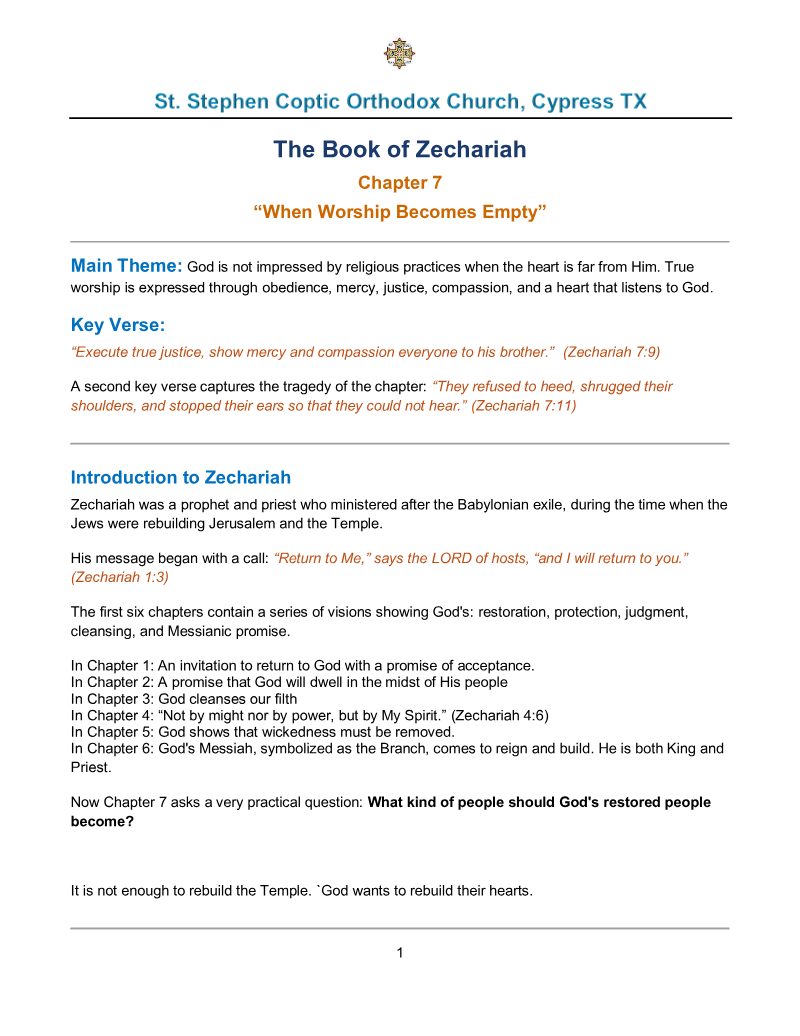
When Worship Becomes Empty
- Date
- Series
- Minor Prophets
- Theme
- God is not impressed by religious practices when the heart is far from Him. True worship is expressed through obedience, mercy, justice, compassion, and a heart that listens to God.
Key verse
“Execute true justice, show mercy and compassion everyone to his brother.”
On this page
Outline
A second key verse captures the tragedy of the chapter: “They refused to heed, shrugged their shoulders, and stopped their ears so that they could not hear.” (Zechariah 7:11)
Introduction to Zechariah
Zechariah was a prophet and priest who ministered after the Babylonian exile, during the time when the Jews were rebuilding Jerusalem and the Temple.
His message began with a call: “Return to Me,” says the LORD of hosts, “and I will return to you.” (Zechariah 1:3)
The first six chapters contain a series of visions showing God's: restoration, protection, judgment, cleansing, and Messianic promise.
In Chapter 1: An invitation to return to God with a promise of acceptance.
In Chapter 2: A promise that God will dwell in the midst of His people
In Chapter 3: God cleanses our filth
In Chapter 4: “Not by might nor by power, but by My Spirit.” (Zechariah 4:6)
In Chapter 5: God shows that wickedness must be removed.
In Chapter 6: God's Messiah, symbolized as the Branch, comes to reign and build. He is both King and Priest.
Now Chapter 7 asks a very practical question: What kind of people should God's restored people become?
It is not enough to rebuild the Temple. `God wants to rebuild their hearts.
Part one: A question about fasting. (Verses 1–3)
Some people came to Jerusalem and asked the priests: “Should I weep in the fifth month and fast as I have done for so many years?” (Zechariah 7:3)
Their question sounds spiritual. They are asking about fasting.
But notice what they are really asking: “Do we still need to do this religious practice?”
They have been fasting for years because of the destruction of Jerusalem and the Temple.
Now the Temple is being rebuilt. So they want to know: “Should we continue fasting?”
The question is: “Should I continue this practice now that circumstances have changed?”
But God turns the question around.
God asks: “Whom were you fasting for?”
This is a powerful spiritual examination. We can do the right things for the wrong reasons.
We can: pray, fast, attend Liturgy, serve, give, teach, read Scripture, ….. etc.
And yet ask internally: “What am I getting out of this?”
God wants us to ask: “Am I doing this for God?”
Part two: God Askes; “Did You Really Fast for Me?” (Verses 7:4-7)
God says: “When you fasted and mourned in the fifth and seventh months during those seventy years, did you really fast for Me - for Me?” (Zechariah 7:5)
God's response to their question is unexpected. He doesn't immediately say yes or no. Instead, He asks them to examine their hearts.
The repetition is powerful: “For Me - for Me?”
God is examining their motivation.
Their fasting had become a religious tradition.
They were doing something that was originally connected to repentance and sorrow, but the practice had become disconnected from the heart.
The danger:
A spiritual practice can continue while the spiritual meaning disappears.
You can say the prayers without praying.
You can sing without worshiping.
You can fast without repentance.
You can attend church without encountering Christ.
You can serve without love.
You can know the Bible without obeying it.
This is an important application of Zechariah 7.
Let us ask ourselves: Why do I come to church?
Is it: tradition?.... obligation? ….. habit? …. family expectation? ….. appearance? ….. because everyone else comes?
Or: Am I coming because I love Christ and want to strengthen my relationship with Him?
The difference may not be visible externally.
Two people can stand beside each other in the same Liturgy. One is simply completing a religious obligation. The other is standing before the living God.
The external action is the same. The heart is completely different.
“Should You Not Have Obeyed?”
God reminds them that He had already spoken through earlier prophets.
“Should you not have obeyed the words which the LORD proclaimed through the former prophets...?”
In other words: “You already know what I want.”
God had not left them without instruction.
The problem wasn't lack of information. The problem was lack of obedience.
This is a recurring theme throughout Scripture.
St. James says: “But be doers of the word, and not hearers only.” (James 1:22)
Christianity isn't merely about: knowing the commandment. It is about: living the commandment.
Part three: God’s Desire, What Does God Actually Want? (Verses 7:8-10)
Then God gives a clear answer.
“Execute true justice, show mercy and compassion everyone to his brother.”
And then: “Do not oppress the widow or the fatherless, the alien or the poor.” (Zechariah 7:10)
Notice what God emphasizes.
Justice
“Execute true justice.”
Treat people fairly.
Don't exploit others.
Don't use your position to take advantage of someone weaker.
Mercy
“Show mercy.”
Don't simply ask: “What does this person deserve?”
Ask: “How can I show God's mercy to this person?”
Compassion
God doesn't want cold religious correctness.
He wants hearts that feel the suffering of others and respond.
Care for the Vulnerable
God specifically mentions: widows, orphans, foreigners, poor people.
Why?
Because a person's treatment of vulnerable people reveals the condition of his heart.
God's Concern for the Vulnerable
This theme appears repeatedly throughout Scripture.
Psalm 68:5 calls God: “A father of the fatherless and a defender of the widows.”
James says: “Pure and undefiled religion before God and the Father is this: to visit orphans and widows in their trouble...” (James 1:27)
Notice the connection:
True religion produces love.
If our worship does not change the way we treat people, something is wrong.
A Powerful Contrast
Zechariah 7 gives us two possible forms of religion.
Empty religion says:
I fast, … I attend, … I pray, … I serve, … I know.
True worship says:
I obey, … I love, … I forgive, … I show mercy, … I care, … I serve, … I seek justice.
God is not asking us to choose between worship and service.
He wants: Worship that produces service.
The Heart of the Matter (Zechariah 7:10)
God says: “Let none of you think evil in your heart against your brother.” (Zechariah 7:10)
Notice that God moves from external behavior to the heart.
The problem isn't only what we do. It is what we think.
Jesus teaches the same principle. Sin begins inside: hatred, jealousy, lust, pride, resentment, unforgiveness.
Christianity is not simply behavior modification. Christ wants to transform the heart.
Part four: “They Refused to Listen” (Verses 7:11-14)
Now comes the tragedy.
“But they refused to heed, shrugged their shoulders, and stopped their ears so that they could not hear.”
They: refused to listen, turned away, stopped their ears, hardened their hearts
Verse 12 says: “Yes, they made their hearts like flint.”
The problem wasn't that God wasn't speaking. God was speaking.
The problem was: They didn't want to hear.
How Does a Heart Become Hard?
Usually, hardness doesn't happen overnight. It happens gradually.
One ignored conviction, then another. One compromise, then another. One unforgiven offense, Then another.
One time saying: “I know what God says, but...”
Eventually the heart becomes less sensitive to God's voice.
The danger is not only committing sin. The greater danger is becoming comfortable with sin.
The “Shoulder” Problem
Verse 11 says: “They shrugged their shoulders.”
The image suggests turning away stubbornly.
It is like God says: “Listen.”
And the person responds: “I don't want to.”
This is rebellion.
There is a major difference between: “Lord, I struggle to obey.”
and: “Lord, I refuse to obey.”
The first can become a place of growth. The second becomes hardness.
“As He Called, They Would Not Listen”
God says: “Thus it happened: Just as He proclaimed and they would not hear, so they called out and I would not listen.” (Zechariah 7:13)
This is a serious warning. They ignored God when He called. Then, when they needed God, they called on Him. But God allowed them to experience the consequences of their rebellion.
This is not because God is difficult. It is because sin has consequences.
Galatians 6:7 says: “Whatever a man sows, that he will also reap.”
God's Silence is Sometimes the Consequence of Our Refusal
There are times when we ask: “Why doesn't God answer me?”
Zechariah asks us to consider another question: “Have I been listening to God?”
We should never assume that every unanswered prayer is caused by sin.
The Bible gives many examples of faithful people who experienced God's apparent silence.
But Zechariah does teach an important principle: We cannot continually reject God's voice and expect to remain spiritually sensitive to it.
Christ in Zechariah 7
1. Christ is the One who gives us a new heart
The people had hearts like flint. The prophets promised something greater.
God says through Ezekiel: “I will give you a new heart and put a new spirit within you.” (Ezekiel 36:26)
This promise is fulfilled through the saving work of Christ and the gift of the Holy Spirit.
Christianity isn't: “Try harder to become nicer.”
It is: “Let Christ transform your heart.”
2. Christ Condemned Empty Religion
Jesus repeatedly confronted religious leaders who had external religion without internal transformation.
He quoted Isaiah: “These people draw near to Me with their mouth, And honor Me with their lips, But their heart is far from Me.” (Matthew 15:8)
That sounds remarkably similar to Zechariah 7.
Zechariah: “Did you really fast for Me?”
Jesus: “Your heart is far from Me.”
The problem is the same: External religion without a surrendered heart.
3. Christ Taught Mercy
Jesus quoted Hosea: “I desire mercy and not sacrifice.” (Matthew 9:13)
This does not mean sacrifice or worship is unimportant.
It means: God rejects religious actions that are disconnected from love and mercy.
Jesus demonstrated this Himself.
He: touched lepers, welcomed sinners, healed the sick, fed the hungry, defended the weak, forgave enemies, restored the broken.
Christ didn't simply preach mercy. He practiced mercy.
4. Christ Is the Perfect Example of True Worship
Jesus perfectly fulfilled what Zechariah 7 teaches. His life was completely oriented toward the Father.
He says: “I always do those things that please Him.” (John 8:29)
His worship was not empty.
His obedience was complete.
His love was sacrificial.
His compassion was genuine.
And ultimately He gave Himself on the Cross.
The Cross is the ultimate expression of how Christ pleased the Father and did His will.
A Patristic Perspective
The Fathers consistently warned against external religion without transformation of the heart.
St. John Chrysostom repeatedly emphasized that fasting has little value if it is not accompanied by mercy and care for others. His famous teaching on fasting stresses that abstaining from food while continuing to harm or neglect our neighbor misses the purpose of fasting.
This principle is beautifully consistent with Zechariah 7:
True fasting changes how we treat people.
The Fathers also frequently taught that prayer and worship must lead to a transformed life.
This is very close to the message of St. James: “Faith by itself, if it does not have works, is dead.” (James 2:17)
Practical Applications
Application 1: Examine the “Why” Behind Your Worship
Ask: “Why do I do what I do spiritually?”
Why do I: pray? … fast? … attend Liturgy? … serve? … give? … read Scripture?
The same action can be done for God or for ourselves.
Before asking “What am I doing?”, Ask: “For whom am I doing it?”
Application 2: Let Fasting Produce Love
When we fast, don't simply ask: “What food am I giving up?”
Ask: “What sin am I giving up?”
And: “Who can I help because I am fasting?”
For example: Fast from complaining → practice gratitude.
Fast from criticism → speak encouragement.
Fast from anger → practice patience.
Fast from entertainment → spend time with someone lonely.
Fast from unnecessary spending → help someone in need.
A fast that doesn't change our heart has missed its purpose.
Application 3: Listen Before God Has to Shout
Ask: “What has God already been telling me?”
Maybe God has already spoken about: forgiveness, … honesty, … purity, … humility, … reconciliation, … generosity, … prayer, … service.
Don't wait for another sign. Obey the light God has already given you.
Application 4: Examine Your Treatment of Others
God specifically mentions the vulnerable.
Ask: “How do I treat people who cannot give me anything in return?”
This is a powerful test of Christian character.
How do I treat: the elderly?, … children?, … the poor?, … newcomers?, … immigrants?, … people who disagree with me?, … people who serve behind the scenes?, … people who have no influence?
Jesus said: “Inasmuch as you did it to one of the least of these My brethren, you did it to Me.” (Matthew 25:40)
Application 5: Don't Let Tradition Replace Relationship
Tradition can be beautiful and valuable. The problem is not tradition. The problem is tradition without the heart.
We can preserve: the prayers, … hymns, … rituals, … customs, …
while losing: repentance, … love, … humility, … mercy, … Christ.
The goal is not to abandon tradition. The goal is to fill our tradition with a living relationship with Christ.
Application 6: Don't Harden Your Heart
Ask yourself: “Is there something God has been telling me that I keep postponing?”
Maybe: “Forgive.” … “Apologize.” … “Stop.” … “Go.” … “Give.” … “Serve.” … “Change.”
The first time God's voice convicts us, it can be strong. If we repeatedly ignore it, our sensitivity decreases. Respond while your heart is tender.
Connection With the Previous Chapters
There is a beautiful progression through Chapters 4 - 7:
Chapter 4: “Not by might nor by power, but by My Spirit.” God gives us His power.
Chapter 5: “This is Wickedness!” God removes sin.
Chapter 6: “Behold, the Man whose name is the BRANCH.” God gives us Christ the King and Priest.
Chapter 7: “Execute true justice, show mercy and compassion.” Christ transforms our relationships and behavior.
So the message becomes: Spirit → Cleansing → Christ → Compassion
Closing Prayer
“Lord Jesus Christ, forgive us when our worship becomes routine and our spiritual practices become empty. Search our hearts and show us whether we are truly doing everything ‘for You.’ Give us hearts that listen to Your voice and respond with obedience. Soften every hardened place within us. Teach us to show justice, mercy, and compassion. Help us to see You in the poor, the lonely, the forgotten, and those who need our love. May our fasting lead to holiness, our prayer lead to obedience, and our worship lead to love. Make our hearts a dwelling place for You, and let our lives reflect Your mercy to everyone around us. Amen.”
11 pages in the handout
Minor Prophets
More in this series
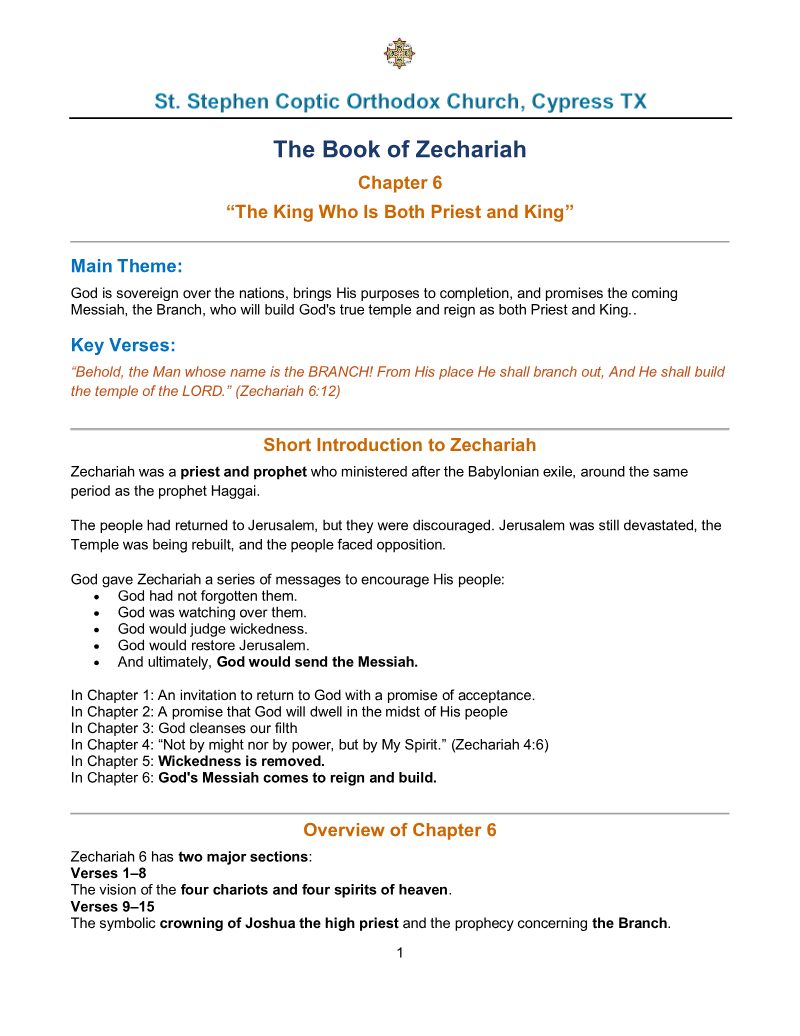
Zechariah 6
The King Who Is Both Priest and King
Part 8 · Previous
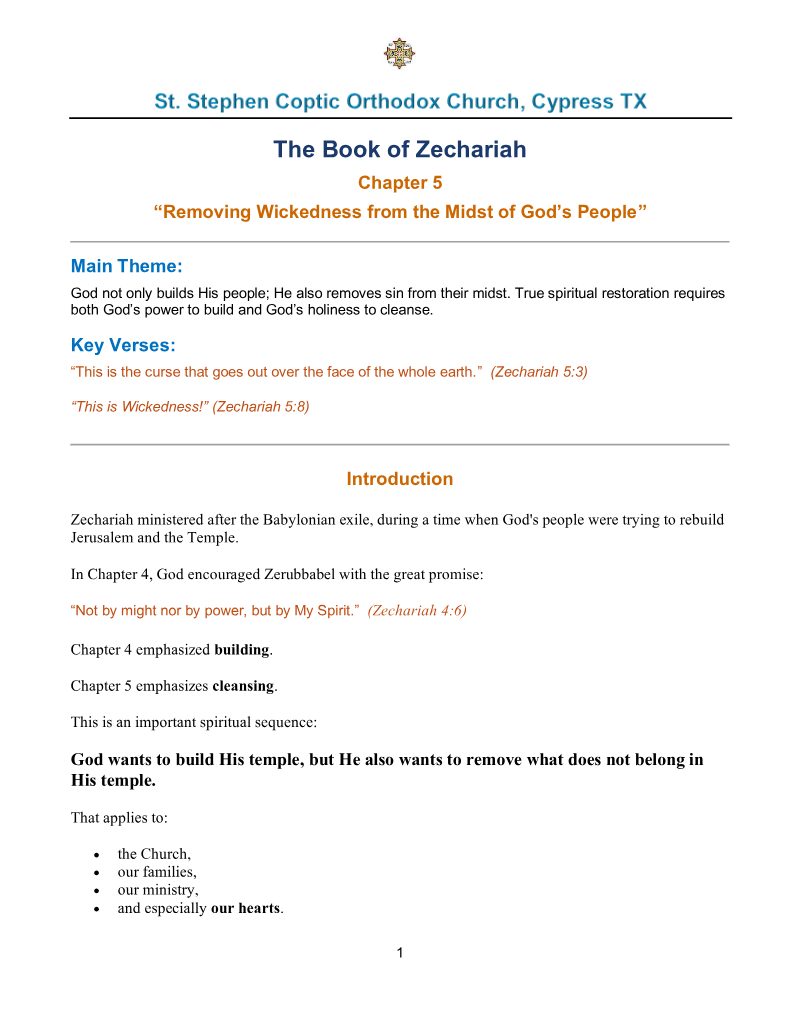
Zechariah 5
Removing Wickedness from the Midst of God’s People
Part 7
The Minor Prophets series
13 studies so far, newest first. The next part appears here after the next English Bible Study.
See the whole series