
Minor Prophets · Part 14
Zechariah 12
The Pierced One: The Spirit of Grace, Repentance, and the Fountain of Salvation
Zechariah 12 reveals God's power to defend His people, His promise to pour out the Spirit of grace and supplication, and the mysterious prophecy of the One who would be pierced. The chapter points us to Jesus Christ crucified, whose wounds reveal God's love and whose sacrifice opens the way to repentance, forgiveness, and spiritual renewal.
- Date
- Series
- Minor Prophets
Key verse
“Then they will look on Me whom they pierced. Yes, they will mourn for Him as one mourns for his only son.”
On this page
Outline
1. Introduction to Zechariah and Chapter 12
Zechariah prophesied after the return of God's people from Babylonian exile. The earlier chapters emphasized rebuilding, repentance, and the restoration of Jerusalem. Chapters 9–11 introduced the coming humble King, the restoration of God's flock, and the tragic rejection of the Shepherd for thirty pieces of silver.
Chapter 12 begins a new prophetic section, extending through chapters 12–14. It describes Jerusalem under threat, God's intervention, the spiritual renewal of His people, and the mourning that follows the recognition of the pierced One.
The chapter has three main parts:
- Verses 1–4: God protects Jerusalem and defeats the nations gathered against her.
- Verses 5–9: God strengthens the leaders and inhabitants of Judah and promises to defend Jerusalem.
- Verses 10–14: God pours out the Spirit of grace and supplication, and the people mourn when they look upon the One whom they pierced.
The central spiritual part of this chapter is remarkable:
- God protects His people.
- God strengthens His people.
- God opens their eyes.
- God gives them a spirit of repentance.
- They recognize the One they have pierced and mourn.
The chapter teaches us that God's ultimate victory is not merely the defeat of external enemies; it is the transformation of the human heart.
2. God Is the Creator and Defender of His People (Verses 1–4)
A. The God who formed the heavens and the earth (Verse 1)
The chapter begins by declaring God's identity as the One who:
- Stretches out the heavens.
- Lays the foundation of the earth.
- Forms the spirit of man within him.
Why does the prophet begin with creation?
Because before describing the threats against Jerusalem, he reminds the people who their God is.
The God who created the universe is powerful enough to protect His people. The God who formed the human spirit knows the deepest thoughts, fears, and needs of every person.
This gives us two important truths:
God is powerful enough to help us, and He knows us deeply enough to understand us.
We sometimes approach God as though He were limited by our circumstances. Zechariah reminds us that the One we pray to is the Creator of all things.
B. Jerusalem becomes an immovable stone (Verses 2–3)
Jerusalem is described as a cup that causes surrounding peoples to stagger and as a heavy stone that injures those who try to lift it. The image communicates that the nations gathering against Jerusalem will discover that they cannot overcome God's purposes.
This is not a promise that God's people will never experience suffering. Rather, it is an assurance that opposition cannot ultimately defeat God's plan.
C. Christ and His Church
In the New Testament, the Church is described as God's people, built upon Christ.
Read Matthew 16:18. Jesus promises that the gates of Hades will not prevail against His Church.
The Church has experienced persecution, division, opposition, and hardship throughout history. Yet Christ remains its foundation and Head.
Read Ephesians 2:19–22. Christ is the chief cornerstone, and believers are being built together into a dwelling place of God in the Spirit.
The security of the Church does not depend on political influence, buildings, money, or human power. Its security is in Christ.
Patristic reflection
St. Augustine, in The City of God, distinguishes the earthly kingdoms that rise and fall from the enduring City of God. This helps us understand that the ultimate security of God's people is not found in earthly power, but in belonging to His everlasting Kingdom.
Practical applications
- When facing opposition: Remember that God is greater than the circumstances confronting you.
- When serving the Church: Do not measure the Church's strength only by numbers, resources, or public recognition.
- When feeling weak: Remember that the Creator who formed your spirit knows your struggles.
- When anxious about the future: Place your confidence in God's sovereignty rather than trying to control everything.
Reflect
When I face difficulties, do I focus more on the size of the problem or on the greatness of God?
3. God Strengthens His People in the Day of Battle (Verses 5–9)
A. “The LORD of hosts is their God” (Verses 5 & 6)
The leaders of Judah recognize that their strength comes from the Lord. They do not ultimately depend on their own abilities. Verse 6 uses images of fire consuming wood and a torch setting sheaves on fire. These images describe God's power to overcome the forces gathered against His people.
The important lesson is that God does not merely ask His people to face their battles; He promises to be their strength.
Read Psalm 20:7. Some trust in chariots and some in horses, but God's people remember the name of the Lord.
B. God protects the weak (Verse 7)
God promises to save the tents of Judah first, so that the house of David and the inhabitants of Jerusalem will not exalt themselves over Judah. This is an important detail. God does not want the leaders of Jerusalem to boast as though their victory came from their own strength or status. He protects the weaker and less prominent parts of His people. This reflects a principle found throughout Scripture: God's grace is not reserved for those who appear powerful or important.
Read 1 Corinthians 12:22–25. St. Paul teaches that the members of the body that seem weaker are necessary and deserve special honor.
C. God makes His people strong (Verse 8)
The prophet describes a remarkable transformation:
- The weak among them will be like David.
- The house of David will be like God, like the Angel of the Lord before them.
David was remembered as a mighty warrior and a king who trusted in God. The promise is that even those who appear weak will receive strength from the Lord. The expression concerning the house of David points to extraordinary divine strengthening. It should not be understood as making human beings equal to God. Rather, God promises to equip His people with strength beyond their natural ability.
Read 2 Corinthians 12:9–10. St. Paul discovers that God's strength is made perfect in weakness.
This is a beautiful Christian principle: our weakness does not have to be an obstacle to God's work. When we surrender ourselves to Him, His grace can work through us.
D. God defeats the enemies of His people (Verse 9)
God promises to seek the destruction of the nations that come against Jerusalem. The immediate picture is God's defense of Jerusalem. In the wider biblical story, we also see that Christ defeats the deeper enemies of humanity: sin, death, and the devil.
Read Hebrews 2:14–15. Through His death, Christ destroys the power of death and delivers those held in bondage by its fear.
Practical applications
- Do not underestimate what God can accomplish through someone who feels weak.
- Do not take credit for spiritual victories that come through God's grace.
- Give special attention to members of the Church who are quiet, struggling, elderly, or overlooked.
- When facing spiritual battles, depend on prayer, Scripture, the sacraments, and the fellowship of the Church.
Reflect
What weakness in my life might God use as an opportunity to reveal His strength?
4. The Spirit of Grace and Supplication: God Opens the Heart to Repentance (Verse 10)
This is the central verse of the chapter and an important Messianic prophecy in the Old Testament.
A. “I will pour on the house of David and on the inhabitants of Jerusalem the Spirit of grace and supplication” (Verse 10)
Notice the order:
- God pours out His Spirit.
- The people receive grace and a spirit of supplication.
- Their eyes are opened.
- They look upon the One whom they pierced.
- They mourn and repent.
Repentance is not simply a human decision to become better. It is also a work of God's grace in the heart. The Holy Spirit awakens our conscience, reveals our sin, and draws us toward Christ.
Read John 16:7–11. Jesus teaches that the Holy Spirit convicts the world concerning sin, righteousness, and judgment. We cannot produce genuine spiritual renewal through external pressure alone. We need the work of the Holy Spirit within us.
B. “They will look on Me whom they pierced”
This is the most remarkable statement in the chapter.
God says, “They will look on Me whom they pierced.”
The speaker is the Lord, yet the One pierced is also described as another person: “they will mourn for Him.”
The language is mysterious and profound. Christians see here a prophetic revelation of the mystery of Christ: the One who is pierced is truly human, yet He is also the divine Son who shares the identity and glory of God.
C. Fulfillment in the crucifixion of Christ
Read John 19:31–37. When the soldiers came to Jesus, they found that He was already dead. One of the soldiers pierced His side with a spear, and blood and water came out. St. John then explicitly connects this event to Zechariah's prophecy: “They shall look on Him whom they pierced.”
This is an unmistakable connection between Zechariah 12:10 and the crucifixion. The prophet sees ahead to the suffering of the Messiah. The One who was promised as the humble King in chapter 9, and who was betrayed for thirty pieces of silver in chapter 11, is now revealed as the Pierced One.
D. The pierced side of Christ: Blood and water
The Gospel of St. John gives special attention to the blood and water that flowed from Christ's side. The early Church saw profound spiritual significance in this event.
- The blood points to Christ's sacrifice and the forgiveness of sins.
- The water points to cleansing and the life given through the Holy Spirit.
- Together, they remind us that salvation flows from Christ's sacrifice.
- Also, they together reveal the fact that Christ is alive and dead at the same time.
Read 1 John 5:6–8 and 1 Corinthians 10:16. In the sacramental life of the Church, we encounter the saving gifts of Christ through the mysteries of the Church, especially Baptism and the Eucharist.
The pierced side reminds us that the Church receives her life from Christ, who gave Himself for her.
E. What does it mean to look upon the Pierced One?
There is a difference between simply looking at a crucifix and truly contemplating the Crucified Christ.
We can look at the Cross as a religious symbol without allowing it to change our lives. But when we truly look upon Christ crucified, we begin to recognize:
- The seriousness of our sin.
- The depth of God's love.
- The cost of our salvation.
- The need for repentance.
- The greatness of divine mercy.
Consider the Roman centurion at the Cross.
Read Mark 15:37–39. When the centurion witnessed the death of Jesus, he recognized something extraordinary and confessed that Jesus was the Son of God.
The Cross can become the place where our eyes are opened.
F. The difference between regret and repentance
Judas regretted betraying Jesus, but his sorrow led him into despair.
Peter wept bitterly after denying Jesus, but he returned to the Lord and was restored.
Both experienced sorrow and regret, but their responses were different.
Read 2 Corinthians 7:10. St. Paul distinguishes godly sorrow, which produces repentance leading to salvation, from worldly sorrow, which produces death.
Zechariah's prophecy is not simply about people feeling sad. It is about a heart awakened by grace, turning toward the pierced Savior.
Patristic reflection
St. Cyril of Alexandria, in his commentary on the Gospel of John, emphasizes the significance of the blood and water flowing from Christ's side. The event reveals the reality of Christ's death and points to the spiritual gifts that flow from Him for the life of the Church.
St. John Chrysostom, in his Homilies on the Gospel of John, reflects on the blood and water as signs of the mysteries of the Church. He connects the water with Baptism and the blood with the Eucharist, showing that the Church's life comes from the Crucified Christ.
Practical applications
- Spend time contemplating the Cross, not only during Holy Week but throughout the year.
- When you sin, do not hide from Christ. Look toward Him and return in repentance.
- During confession, do not focus only on feeling guilty; seek genuine transformation.
- When you receive the Eucharist, remember that you are approaching the One who gave His life for you.
- Ask the Holy Spirit to reveal the areas of your heart that still need healing.
Reflect
When I look at the Cross, do I see only the suffering of Jesus, or do I also recognize the sin in my life and the love that He has shown me?
5. A Great Mourning: The Repentance of God's People (Verses 11–14)
A. “There shall be a great mourning in Jerusalem” (Verse 11)
The prophet compares the mourning in Jerusalem to the mourning at Hadad Rimmon in the plain of Megiddo.
This likely recalls the great mourning associated with the death of King Josiah, who was killed at Megiddo (2 Chronicles 35:20–25).
Josiah was a beloved king whose death brought great sorrow to the nation. Zechariah uses this image to describe the depth of mourning that will occur when the people recognize the One whom they pierced.
But this mourning is not merely national grief. It is a spiritual awakening. The people finally recognize the One they rejected.
B. Each family mourns individually
One of the interesting details is that Zechariah mentions different families:
- The family of David.
- The family of Nathan.
- The family of Levi.
- The family of Shimei.
- All the remaining families.
The mourning is both communal and personal.
It is not enough for the nation as a whole to acknowledge its sin. Each family must respond. This gives us an important spiritual lesson: repentance cannot remain general or theoretical. It must become personal. It is easy to say, “Our society needs to repent,” or “The world has become sinful.” But the real question is: Have I repented? Have I allowed God to change my heart?
C. Why does Zechariah mention David, Nathan, Levi, and Shimei?
The names represent different parts of Israel's community.
- David: The royal family and leadership.
- Nathan: A branch of David's family and a prophet representing another kind of leadership.
- Levi: The priestly family, representing spiritual leadership.
- Shimei: A family associated with the tribe of Levi, representing teachers of the Law.
The repetition emphasizes that repentance reaches every level of society: rulers, priests, families, and ordinary people.
No one is exempt from the need for repentance.
D. The Orthodox understanding of repentance
In the spiritual life of the Church, repentance is not a single emotional moment. It is a continuing journey of returning to God.
We see this expressed in:
- The Agpeya: The repeated prayers of repentance and supplication.
- The sacrament of Confession: Bringing our sins before Christ through the priest and receiving spiritual guidance and absolution.
- The Eucharist: Approaching Christ with repentance, faith, and preparation.
- Fasting: Training the heart to reject sin and seek God.
- Daily examination of conscience: Asking the Holy Spirit to reveal what needs to change.
St. Isaac the Syrian speaks of repentance as a gift and a continual renewal of life. His teaching reminds us that repentance is not simply regret over the past; it is the beginning of a new direction toward God.
Practical applications
- Make repentance personal. Identify specific sins rather than speaking only in general terms.
- Do not allow guilt to turn into despair.
- Teach children that saying “I am sorry” should be followed by a willingness to change.
- Encourage families to pray together and ask forgiveness from one another.
- Make the Cross the center of your spiritual life.
Reflect
Is my sorrow over sin leading me to change, or am I simply feeling bad without taking steps toward repentance?
6. Highlighting Christ in Zechariah 12
| Zechariah 12 | Fulfillment and meaning in Christ |
|---|---|
| Verse 1: God forms the human spirit | Christ is the Creator and giver of life (John 1:1–3). Christ protects His Church, which He promised to preserve (Matthew |
| Verses 2–4: God defends Jerusalem | 16:18). |
| Verses 5–9: God strengthens His people Christ's grace is made perfect in weakness (2 Corinthians 12:9). | |
| Verse 10: The Spirit of grace and supplication | The Holy Spirit convicts the heart and draws people to repentance (John 16:8). |
| Verse 10: The One whom they pierced | Fulfilled in the crucifixion of Jesus (John 19:34–37). The recognition of Christ leads to repentance and spiritual renewal |
| Verses 11–14: Great mourning | (Acts 2:36–38). |
The central message:
The pierced Christ is not merely an object of our sympathy. He is our Savior. When we look upon Him with faith, the Holy Spirit opens our hearts to repentance, and His sacrifice becomes the source of our forgiveness and new life.
7. Summary and Main Takeaways
- God is sovereign: The Creator of heaven and earth is able to defend and strengthen His people.
- God strengthens the weak: Our weakness can become an opportunity for His grace to work.
- God gives the Spirit of repentance: Genuine repentance begins with God's grace working in the heart.
- Christ is the Pierced One: Zechariah's prophecy finds its fulfillment in the crucifixion of Jesus.
- The Cross reveals God's love: The blood and water from Christ's side remind us of the salvation and spiritual life that flow from Him.
- Repentance must be personal: Each person and family must respond to God's call.
- Sorrow must lead to transformation: Godly sorrow brings us back to Christ rather than pushing us into despair.
One sentence to remember
When we truly look upon the Pierced Christ, we discover both the seriousness of our sin and the immeasurable greatness of God's love, and His Spirit leads us to genuine repentance.
Closing Prayer
O Lord Jesus Christ, our crucified and risen Savior, we thank You for Your immeasurable love, revealed through Your precious Cross and the blood and water that flowed from Your side.
Pour upon us the Spirit of grace and supplication. Open our eyes to recognize You, our hearts to love You, and our consciences to recognize our sins.
Grant us true repentance, not merely sorrow over our failures, but a sincere desire to change and return to You. Keep us from despair, pride, and spiritual indifference. Teach us to look upon Your Cross with faith and gratitude. Strengthen Your Church, protect our families, and unite us in Your love. May Your Holy Spirit continually renew our hearts, so that our lives may bear witness to the salvation You have given us.
Through the intercessions of St. Mary, the Mother of God, St. Joseph the Carpenter, St. Stephen the Protomartyr and all Your saints, hear us as we pray. Amen.
7 pages in the handout
Minor Prophets
More in this series
Zechariah 11
The Rejected Shepherd: The Price of Betrayal and the Danger of False Shepherds
Part 13 · Previous
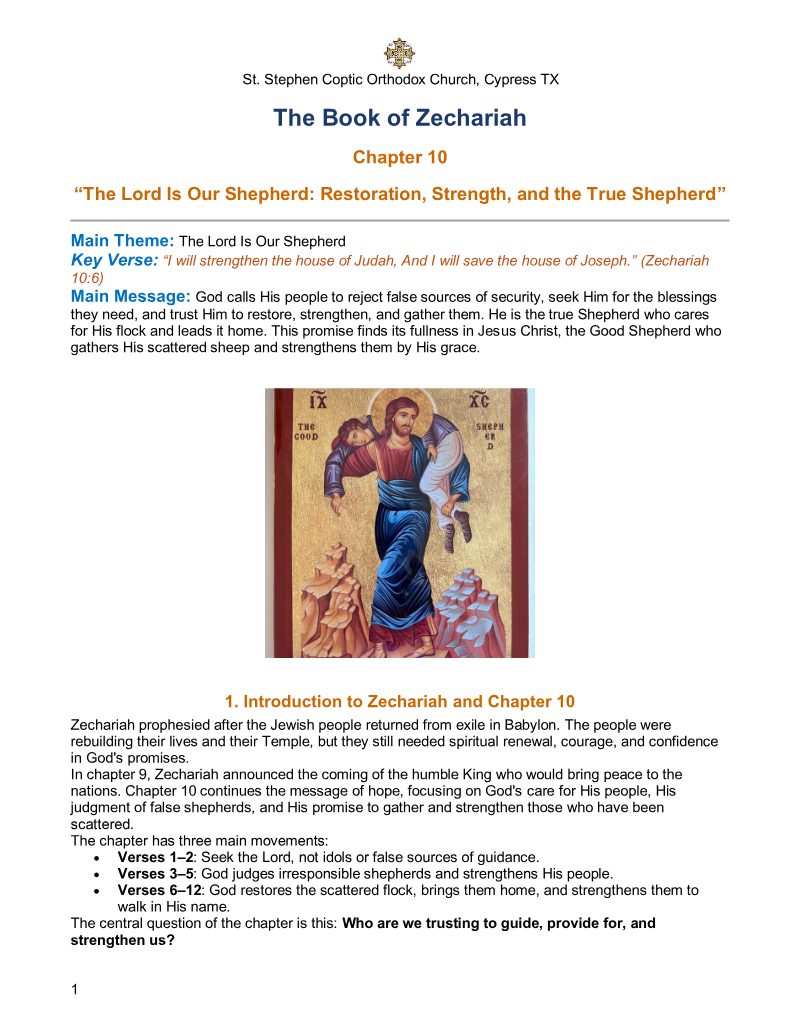
Zechariah 10
The Lord Is Our Shepherd: Restoration, Strength, and the True Shepherd
Part 12
The Minor Prophets series
14 studies so far, newest first. The next part appears here after the next English Bible Study.
See the whole series