
الأنبياء الصغار · الجزء 8
Zechariah 6
The King Who Is Both Priest and King
- التاريخ
- السلسلة
- الأنبياء الصغار
- الفكرة الرئيسية
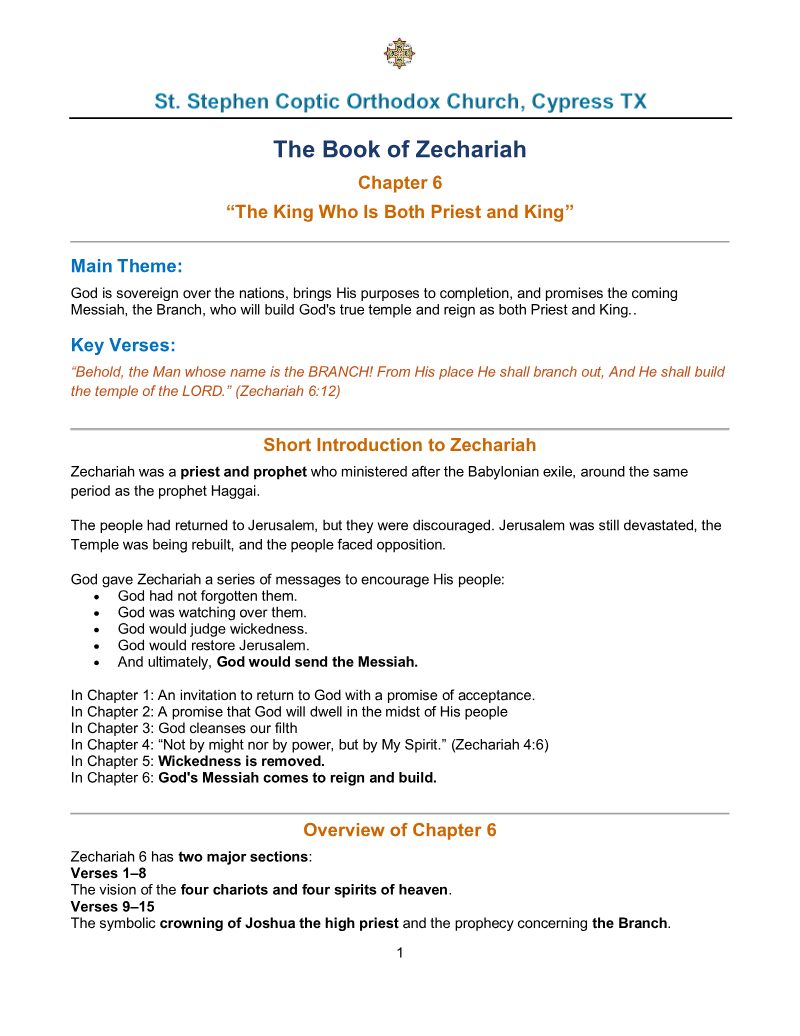
- God is sovereign over the nations, brings His purposes to completion, and promises the coming Messiah, the Branch, who will build God's true temple and reign as both Priest and King..
الآية الرئيسية
“Behold, the Man whose name is the BRANCH! From His place He shall branch out, And He shall build the temple of the LORD.”
في هذه الصفحة
المخطط
Short Introduction to Zechariah
Zechariah was a priest and prophet who ministered after the Babylonian exile, around the same period as the prophet Haggai.
The people had returned to Jerusalem, but they were discouraged. Jerusalem was still devastated, the Temple was being rebuilt, and the people faced opposition.
God gave Zechariah a series of messages to encourage His people:
- God had not forgotten them.
- God was watching over them.
- God would judge wickedness.
- God would restore Jerusalem.
- And ultimately, God would send the Messiah.
In Chapter 1: An invitation to return to God with a promise of acceptance.
In Chapter 2: A promise that God will dwell in the midst of His people
In Chapter 3: God cleanses our filth
In Chapter 4: “Not by might nor by power, but by My Spirit.” (Zechariah 4:6)
In Chapter 5: Wickedness is removed.
In Chapter 6: God's Messiah comes to reign and build.
Overview of Chapter 6
Zechariah 6 has two major sections:
Verses 1–8
The vision of the four chariots and four spirits of heaven.
Verses 9–15
The symbolic crowning of Joshua the high priest and the prophecy concerning the Branch.
The chapter ends with an extraordinary Messianic promise:
“Yes, He shall build the temple of the LORD. He shall bear the glory, and shall sit and rule on His throne; so He shall be a priest on His throne.”
This verse is a very important verse in the Old Testament about the coming Messiah.
The Four Chariots — Zechariah 6:1-8
Zechariah says: “Then I turned and raised my eyes and looked, and behold, four chariots were coming from between two mountains, and the mountains were mountains of bronze.” (Zechariah 6:1)
The four chariots are pulled by different colored horses.
The angel explains: “These are four spirits of heaven, who go out from their station before the Lord of all the earth.” (Zechariah 6:5)
The exact identification of the colors is less important than the overall message.
The central message is: God is actively governing His world.
The nations may appear to be in control.
Kings may appear powerful.
Empires may rise and fall.
But behind history is the sovereign God.
God Is the “Lord of All the Earth”
Notice the expression: “The Lord of all the earth.”
God isn't merely:
- the God of Jerusalem,
- the God of Israel,
- the God of one nation.
He is: The Lord of all the earth.
This was particularly important for people who had experienced exile.
They might have wondered: “Where was God when Babylon conquered us?”
God is showing them: I was never absent.
Even when God's people could not understand what He was doing, God remained sovereign.
The Four Chariots and God's Judgment
The chariots go throughout the earth.
This recalls earlier visions in Zechariah and also the imagery of God's heavenly armies.
The message is: God sees what happens among the nations.
Nothing is outside His authority.
Psalm 2 asks: “Why do the nations rage?”
The answer is that earthly powers may resist God, but God's purpose will ultimately prevail.
This is an encouragement for Christians living in an uncertain world.
We may not understand:
- political changes,
- wars,
- economic uncertainty,
- cultural changes,
- persecution,
- personal difficulties.
But we know:
God is still sitting on the throne.
A Practical Question
When the world looks out of control, do I believe God is still in control?
Faith does not mean that we understand everything.
Faith means: I trust the One who does.
The Horses Go Throughout the Earth
Verse 7 says: “Go, walk to and fro throughout the earth.”
God's servants are sent throughout the earth.
This reminds us of the Great Commission: “Go therefore and make disciples of all the nations...” (Matthew 28:19)
The God who sends His heavenly servants throughout the earth is the same God who sends His Church throughout the earth.
The Christian faith is not meant to remain inside our church building.
We are sent:
- to our families,
- to our neighborhoods,
- to our schools,
- to our workplaces,
- to our communities,
- and to the nations.
“My Spirit Is Rested”
After the chariots go forth, the angel says: “See, those who go toward the north country have given rest to My Spirit in the north country.” (Zechariah 6:8)
The meaning is that God's judgment has accomplished its purpose.
God's justice brings peace and rest.
This connects with Chapter 5.
Chapter 5: Wickedness is removed.
Chapter 6: God's judgment brings rest.
There is a spiritual principle here: We cannot experience true peace while deliberately holding on to rebellion against God.
From Vision to Action (Zechariah 6:9-11)
The prophecy now moves from visions to a very unusual command.
God tells Zechariah to receive silver and gold from certain men and make a crown.
Then he is told: “Take the silver and gold, make an elaborate crown, and set it on the head of Joshua the son of Jehozadak, the high priest.” (Zechariah 6:11)
This is surprising. Why?
Joshua is the high priest.
Normally, the priest does not sit on the throne as king.
The king and priest were distinct offices.
But Zechariah is about to reveal something extraordinary.
“Behold, the Man Whose Name Is the BRANCH”
Zechariah says: “Behold, the Man whose name is the BRANCH!”
This title has appeared earlier in Zechariah.
In Zechariah 3:8, God said: “I am bringing forth My Servant the BRANCH.”
The Branch is a Messianic title.
The image comes from a tree that appears cut down but produces new growth.
Israel had experienced:
- exile,
- destruction,
- judgment,
- apparent hopelessness.
But God promises:
A Branch will grow.
From what appears dead, God will bring life.
Christ Is the Branch
This prophecy points ultimately to Jesus Christ.
Other prophets use similar imagery.
Isaiah says: “There shall come forth a Rod from the stem of Jesse, And a Branch shall grow out of his roots.” (Isaiah 11:1)
Jeremiah says: “I will raise to David a Branch of righteousness.” (Jeremiah 23:5)
Jesus is the Branch who comes from David's line.
He appears in humility.
He grows from what looks insignificant.
Yet He becomes the source of salvation for the world.
“He Shall Build the Temple of the LORD”
This is one of the most important statements in the chapter: “He shall build the temple of the LORD.”
At the historical level, Zerubbabel was rebuilding the physical Temple.
But Zechariah is looking beyond that.
The Messiah will build a greater Temple.
Jesus said: “Destroy this temple, and in three days I will raise it up.” (John 2:19)
John explains: “But He was speaking of the temple of His body.” (John 2:21)
Christ Himself becomes the true Temple.
But there is more.
Through Christ, we become God's dwelling place.
Paul says: “You are the temple of God and that the Spirit of God dwells in you.” (1 Corinthians 3:16) Therefore, Christ's work is not simply about constructing a building.
Christ is building a people in whom God dwells.
“He Shall Bear the Glory”
The next statement is extraordinary: “He shall bear the glory.”
This points to Christ's divine glory.
John says: “And the Word became flesh and dwelt among us, and we beheld His glory.” (John 1:14)
Christ does not merely reflect God's glory.
He reveals God's glory.
Paul calls Him: “the brightness of His glory and the express image of His person.” (Hebrews 1:3)
“He Shall Sit and Rule on His Throne”
Zechariah 6:13 says: “He shall sit and rule on His throne.”
The Branch is not merely a servant. He is King.
This points directly to Christ's kingship.
After His Resurrection, Jesus declares: “All authority has been given to Me in heaven and on earth.” (Matthew 28:18)
Christ's Kingdom is not like earthly kingdoms.
He conquers not through armies but through:
- the Cross,
- Resurrection,
- truth,
- love,
- grace,
- and the transformation of human hearts.
The Extraordinary Statement: “A Priest on His Throne”
This may be the most important phrase in Chapter 6: “So He shall be a priest on His throne.” (Zechariah 6:13)
Think about this.
King + Priest.
Under the Old Covenant, these offices were normally separated.
- The king ruled.
- The priest offered sacrifices.
But Zechariah points to One person who will do both.
Jesus Christ.
He is:
King, He reigns.
Priest, He intercedes.
Sacrifice, He offers Himself.
Temple, He is the true meeting place between God and humanity.
Christ Our Great High Priest
The New Testament makes this explicit.
Hebrews says: “We have a great High Priest who has passed through the heavens, Jesus the Son of God.” (Hebrews 4:14)
And: “He always lives to make intercession for them.” (Hebrews 7:25)
This is one of the most beautiful truths of Christianity:
Our King is also our Priest.
The One who has authority over us is the One who loves us enough to intercede for us.
His throne is connected with His sacrifice.
His crown is connected with His Cross.
His glory is revealed through His humility.
The Fathers and the Two Offices of Christ
The Fathers frequently emphasized the unity of Christ's kingship and priesthood.
St. Cyril of Alexandria, in his Christ-centered interpretation of the prophets, sees the prophetic priestly and royal imagery fulfilled in Christ, who unites in Himself what had previously been represented through separate offices.
This is consistent with the teaching of the Letter to the Hebrews: Christ is the eternal High Priest whose priesthood is greater than the Old Testament priesthood.
St. Athanasius likewise emphasizes that Christ truly became man for our salvation while remaining the divine Son.
Therefore:
Christ is not merely another king.
Christ is not merely another priest.
He is the eternal Son who became man to save us.
“The Counsel of Peace Shall Be Between Them Both”
The verse concludes: “And the counsel of peace shall be between them both.”
This is a beautiful statement.
In Christ, there is reconciliation.
Paul says: “For He Himself is our peace.” (Ephesians 2:14)
And: “Having made peace through the blood of His cross.” (Colossians 1:20)
The ultimate peace is not simply the absence of conflict.
Peace is reconciliation with God.
Humanity was separated from God because of sin.
Christ came to restore the relationship.
The Crown as a Memorial (Zechariah 6:14)
The crown is then kept: “as a memorial in the temple of the LORD.”
The crown becomes a reminder.
God wants His people to remember His promise.
This is important spiritually.
We often forget:
- what God has done,
- what God promised,
- how God answered prayers,
- how God carried us through difficulties.
God's people need memorials.
In the Old Testament there were:
- stones,
- altars,
- feasts,
- Passover,
- memorials.
In Christian life we have:
- the Eucharist,
- Scripture,
- worship,
- testimonies,
- remembrance of God's faithfulness.
“Those from Afar Shall Come”
The chapter ends: “Even those from afar shall come and build the temple of the LORD.”
This is another important Messianic element.
God's salvation is not limited to Israel.
People “from afar” will come.
This anticipates the inclusion of the nations.
Isaiah had already prophesied: “The Gentiles shall come to your light.” (Isaiah 60:3)
Jesus sends His disciples: “Make disciples of all the nations.” (Matthew 28:19)
The Church becomes a worldwide temple composed of people from; Israel, Egypt, Africa, Europe, Asia, America, and every nation.
The Branch builds a worldwide spiritual temple.
The Last Phrase: “If You Will Obey”
Verse 15 ends with a condition: “And this shall come to pass if you diligently obey the voice of the LORD your God.”
God’s promises are sure.
But His people are called to respond in obedience.
Grace does not eliminate obedience.
Grace produces obedience.
Jesus said: “If you love Me, keep My commandments.” (John 14:15)
Christ in Zechariah 6
This chapter gives us a remarkable portrait of Christ.
- Christ is the BRANCH: The promised Messiah who brings new life.
- Christ builds God's Temple: Not merely a physical building, but His Body and His Church.
- Christ bears God's glory: He reveals the glory of the Father.
- Christ is King: He sits upon the throne and reigns.
- Christ is Priest: He intercedes for us.
- Christ is our Peace: He reconciles humanity to God.
- Christ gathers the nations: People from afar come into God's kingdom.
- Christ completes God's purpose: What God begins, He brings to completion.
Practical Applications
Application 1: Is Christ truly King in my life?
It is easy to call Jesus: “Lord.”
But the real question is: Who is making the decisions in my life?
Ask:
- Who controls my priorities?
- Who controls my money?
- Who controls my relationships?
- Who controls my time?
- Who controls my future?
If Christ is King, then His will must matter more than mine.
Application 2: Come boldly to Christ the Priest
Jesus is not a distant King. He is our compassionate High Priest.
Hebrews says: “Let us therefore come boldly to the throne of grace.” (Hebrews 4:16)
Notice the beautiful combination: A throne, but a throne of grace.
When you fall: Come to Him.
When you are afraid: Come to Him.
When you have sinned: Come to Him.
When you don't know what to do: Come to Him.
Application 3: Let Christ build His temple in you
Ask: “What is Christ building in me?”
Is He building:
- patience?
- humility?
- purity?
- forgiveness?
- love?
- wisdom?
- perseverance?
God is not finished with you. Your present condition is not your final condition.
The Branch is still building.
Closing Prayer
“Lord Jesus Christ, You are the Branch, the true King and our eternal High Priest. Thank You that You came to build Your Church and to make us living stones in Your spiritual temple. Help us to surrender every area of our lives to Your kingship. When we are afraid, remind us that You are sovereign. When we fall, remind us that You are our compassionate High Priest. When we feel broken or useless, remind us that You are still building Your temple in us. Make us instruments of Your peace and witnesses of Your Kingdom. Help us to obey Your voice and to live each day under Your loving rule. May our lives bring glory to You. Amen.”
8 صفحات في ملف الدراسة
الأنبياء الصغار
المزيد من هذه السلسلة
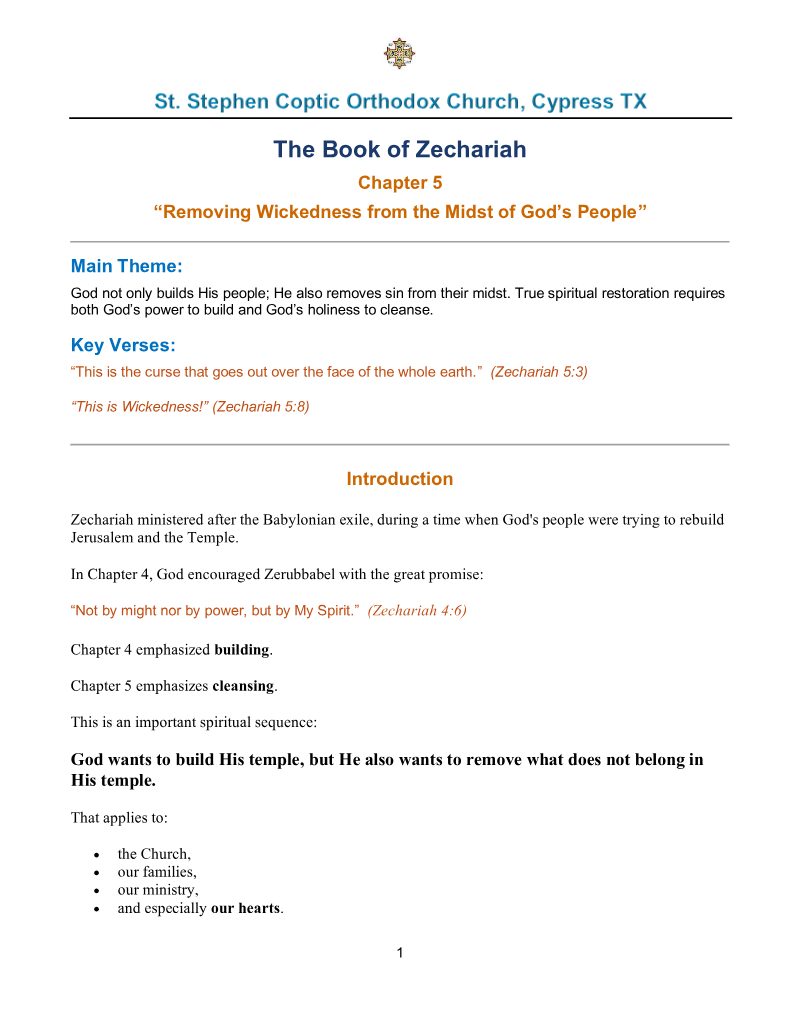
Zechariah 5
Removing Wickedness from the Midst of God’s People
بالإنجليزية فقطالجزء 7 · السابق
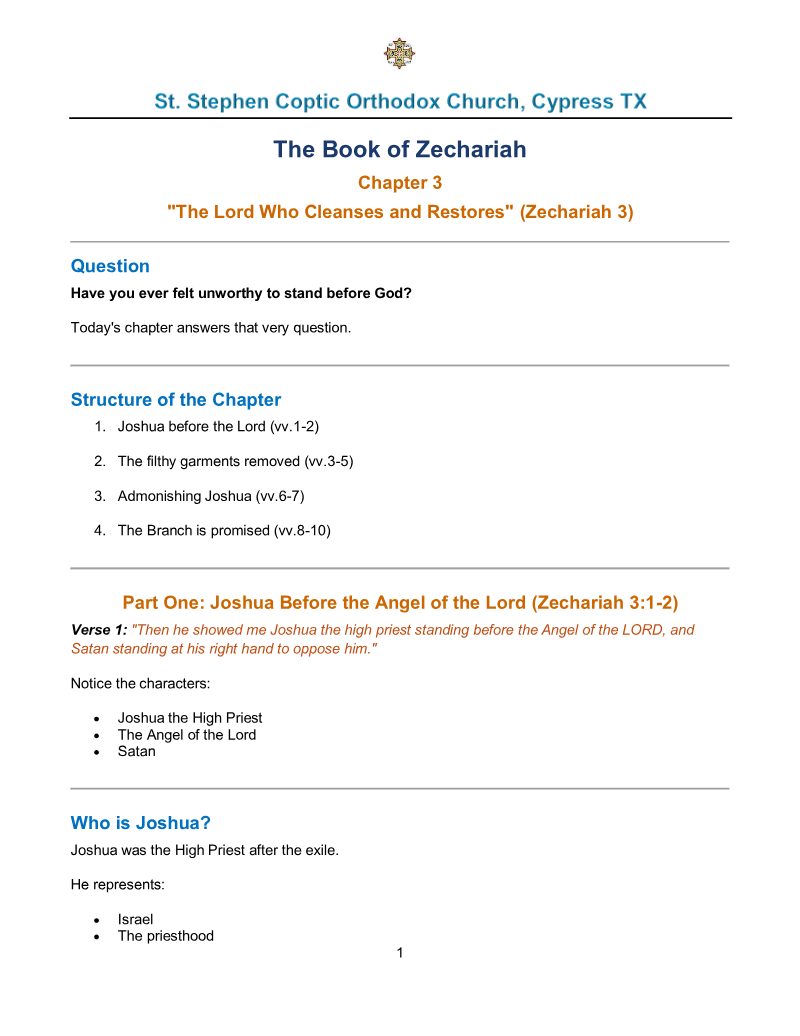
Zechariah 3
"The Lord Who Cleanses and Restores" (Zechariah 3)
بالإنجليزية فقطالجزء 6
سلسلة الأنبياء الصغار
13 دراسة حتى الآن، الأحدث أولًا. يظهر الجزء التالي هنا بعد دراسة الكتاب المقدس الإنجليزية القادمة.
عرض السلسلة كاملة