
Minor Prophets · Part 1
Malachi 4
The Day of the Lord: Divine judgment, healing for the righteous, the forerunner Elijah, and the return of Christ
- Date
- Series
- Minor Prophets
On this page
Outline
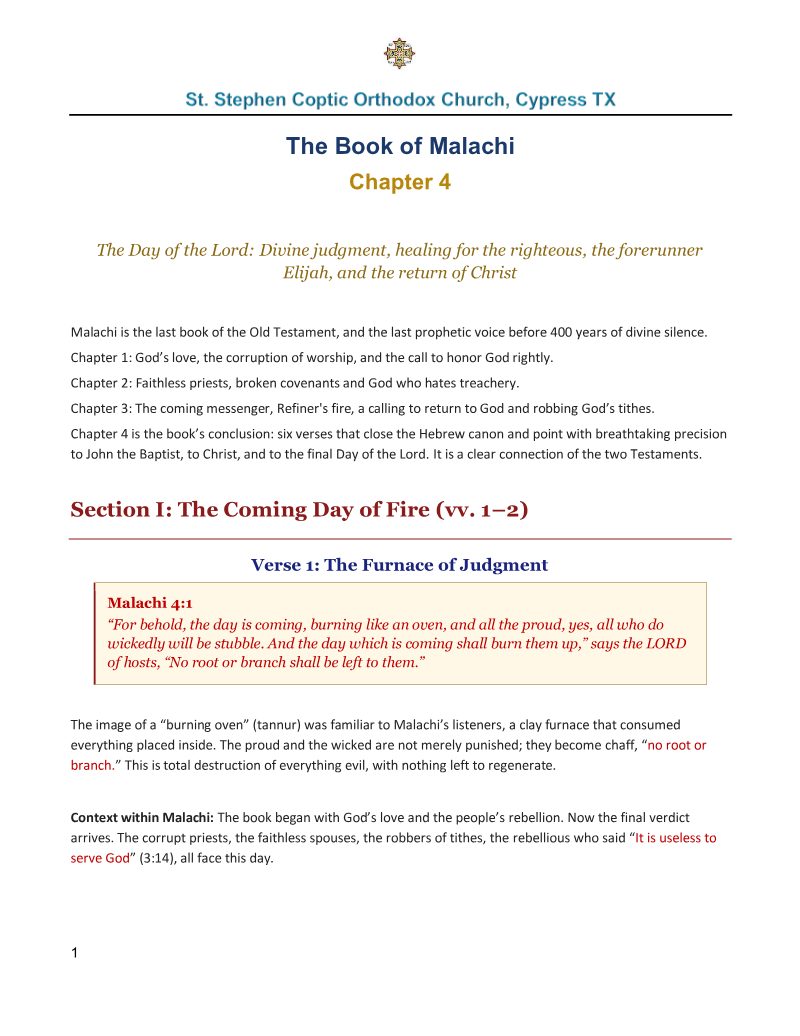
Malachi is the last book of the Old Testament, and the last prophetic voice before 400 years of divine silence.
Chapter 1: God’s love, the corruption of worship, and the call to honor God rightly.
Chapter 2: Faithless priests, broken covenants and God who hates treachery.
Chapter 3: The coming messenger, Refiner's fire, a calling to return to God and robbing God’s tithes.
Chapter 4 is the book’s conclusion: six verses that close the Hebrew canon and point with breathtaking precision to John the Baptist, to Christ, and to the final Day of the Lord. It is a clear connection of the two Testaments.
Section I: The Coming Day of Fire (vv. 1–2)
Verse 1: The Furnace of Judgment
“For behold, the day is coming, burning like an oven, and all the proud, yes, all who do wickedly will be stubble. And the day which is coming shall burn them up,” says the LORD of hosts, “No root or branch shall be left to them.”
The image of a “burning oven” (tannur) was familiar to Malachi’s listeners, a clay furnace that consumed everything placed inside. The proud and the wicked are not merely punished; they become chaff, “no root or branch.” This is total destruction of everything evil, with nothing left to regenerate.
Context within Malachi: The book began with God’s love and the people’s rebellion. Now the final verdict arrives. The corrupt priests, the faithless spouses, the robbers of tithes, the rebellious who said “It is useless to serve God” (3:14), all face this day.
St. Cyril of Alexandria says:
“The wicked are called stubble by the Scripture because they are dry and without moisture, lacking the living water of the Holy Spirit which gives life to the branches. The fire of that Day will test every man’s work, what was built on the Rock shall stand, but what was built on sand shall be fuel for the furnace.”
St. John Chrysostom says:
“Let no man say, ‘I will repent at the last hour.’ The day of the LORD comes as a thief, and the furnace waits for no man’s convenience. The mercy of God is great in this life; His justice is perfect in the next. Therefore, while it is called Today, harden not your heart.”
Verse 2: The Sun of Righteousness
“But to you who fear My name the Sun of Righteousness shall arise with healing in His wings; and you shall go out and grow fat like stall-fed calves.”
Contrast! The same Day that destroys the wicked brings comfort and healing for the God-fearing. “Sun of Righteousness”, the Coptic Church has always understood this as a Messianic title pointing to our Lord Jesus Christ, the true Light of the world (John 8:12).
“Healing in His wings”, the Hebrew kanaf (wings) can also mean “fringes” or “hem.” This connects powerfully to the woman with the hemorrhage who touched the hem of Christ’s garment and was immediately healed (Luke 8:44). Malachi was prophesying this moment!
St. Athanasius the Apostolic says:
“Who else but the Son of God could be called the ‘Sun of Righteousness’? The sun gives light, life, and warmth to all creation without being diminished. So the Word of God, the eternal Light, shines upon all who fear His Name, healing them by His very nature, for in Him there is no darkness at all.”
Application 1: Fear the Name of God in Daily Life
The promise of healing belongs to “you who fear My name.” This is not terror, but holy reverence. Ask yourself this week: Do I fear God more than I fear the opinions of others? Do I make decisions based on pleasing Him? Begin each morning with the Prayer of Thanksgiving, consciously offering your day to the Sun of Righteousness.
Section II: Victory and the Law of Moses (vv. 3–4)
Verse 3: The Victory of the Righteous
“You shall trample the wicked, for they shall be ashes under the soles of your feet on the day that I do this,” says the LORD of hosts.
The image shifts from healing to victory. Those who feared God and perhaps suffered at the hands of the wicked in this life will experience power and victory on the Day of the Lord. The ashes of the wicked, who were previously compared to stubble, become under the feet of the righteous.
This is not vindictiveness. It is the completion of justice. The Coptic tradition sees this as connected to the great Psalm of the Resurrection (Psalm 110/109 LXX): “The LORD said to my Lord, Sit at My right hand, till I make Your enemies Your footstool.” Christ Himself is the fulfillment of this victory. Also, we pray saying “Satan and all his evil powers trample and humiliate them under our feet speedily …. “. This is not a prayer of revenge; it is a cry for the coming of Christ as we pray in the Lord’s prayer saying “Your kingdom come”
St. Cyril of Jerusalem says:
“When we say that Christ trampled death and made it His footstool, we speak not only of His divine power but of the gift He gives to all who are united to Him. The martyrs, the confessors, the saints, all who suffered for righteousness, participate in this victory. Their tears were not wasted; they are the seeds of eternal triumph.”
Reflect
How does the assurance of final divine justice change the way we respond to injustice, persecution, or being treated unfairly today? How did the Coptic martyrs throughout history live this truth?
Verse 4: Remember the Law of Moses
“Remember the Law of Moses, My servant, which I commanded him in Horeb for all Israel, with the statutes and judgments.”
Between two eschatological promises (vv. 1–2 and vv. 5–6), God inserts a very practical command: “Remember the Law.” While awaiting the Day of the Lord, the people must not become passive or spiritually negligent. Fidelity to God’s commands is the proper posture of those who await His coming.
For us as Orthodox Christians, “the Law” has been fulfilled and perfected in Christ (Matthew 5:17). Yet the spirit of this command remains: Remember the Tradition. Keep the fasts. Pray the Hours. Attend the Divine Liturgy. Live the commandments. The Fathers are our guides through the wilderness of this age.
St. Basil the Great says:
“The one who abandons the commandments under the pretext of awaiting some future spiritual experience deceives himself. The Lord will find us doing what He has commanded, not idle.
Remember the Tradition handed down from the Fathers, for it is the guardrail that keeps the soul upon the narrow path until He comes.”
Application 2: Anchor Yourself in the Holy Tradition
In a world of endless spiritual novelty and innovation, Malachi’s command is radical: Remember.
Return to the basic disciplines of Coptic Orthodox life.
This week, strengthen one discipline you may have allowed to weaken: the Agpeya, the Divine Liturgy, fasting on Wednesdays and Fridays, regular Confession, or reading the daily Synaxarium. The Tradition is not a museum; it is a living stream of grace.
Section III: The Coming of Elijah (vv. 5–6)
Verses 5–6: The Forerunner
“Behold, I will send you Elijah the prophet before the coming of the great and dreadful day of the LORD. And he will turn the hearts of the fathers to the children, and the hearts of the children to their fathers, lest I come and strike the earth with a curse.”
These are the last two verses of the Book of Malachi, and they end with a promise and a warning. God promises to send “Elijah” before the Day of the Lord. Our Lord Jesus Christ Himself identified this Elijah with St. John the Baptist: “And if you are willing to receive it, he is Elijah who is to come” (Matthew 11:14; cf. Luke 1:17).
The mission of this forerunner is profoundly relational: to “turn the hearts of the fathers to the children, and the hearts of the children to their fathers.” This speaks of:
- Generational reconciliation: broken family bonds restored
- Spiritual return: children of God returning to their heavenly Father
- Ecclesial unity: the Gentiles being grafted in as children of Abraham (fathers to children)
- The call to repentance that always precedes the encounter with Christ
The alternative is devastating: “lest I come and strike the earth with a curse”, total destruction. The most severe form of divine judgment. The entire mission of the forerunner is to prevent that curse through repentance.
St. John Chrysostom says:
“John came as the voice crying in the wilderness, not to glorify himself but to prepare the way of the Lord. He dressed poorly, ate plainly, lived austerely, and yet the whole of Jerusalem came out to him.
Why? Because true preaching is not in beautiful garments or eloquent words, but in a life that bear s witness to what it proclaims. The preacher must himself be turned to the Father before he can turn others.”
St. Jerome says:
“Malachi speaks of one Elijah in the spirit and power of that prophet, who is John; and of another Elijah in body, who shall come before the terrible Day of Judgment. Let no one confuse the two comings, but let all who live between them use the time of mercy given, before the time of judgment arrives.”
Application 3: Be a Forerunner in Your Own Circle
John the Baptist prepared hearts for Christ. Every believer is called to this same ministry in their sphere of life. Identify one relationship in your family, church, or community that has grown cold, broken, or distant. This week, take the first step of reconciliation. A phone call, a visit, a humble apology. The Day of the Lord draws near, let us not be found dividing what God is calling to be united.
Glory be to God forever and ever. Amen.
5 pages in the handout
Minor Prophets
More in this series
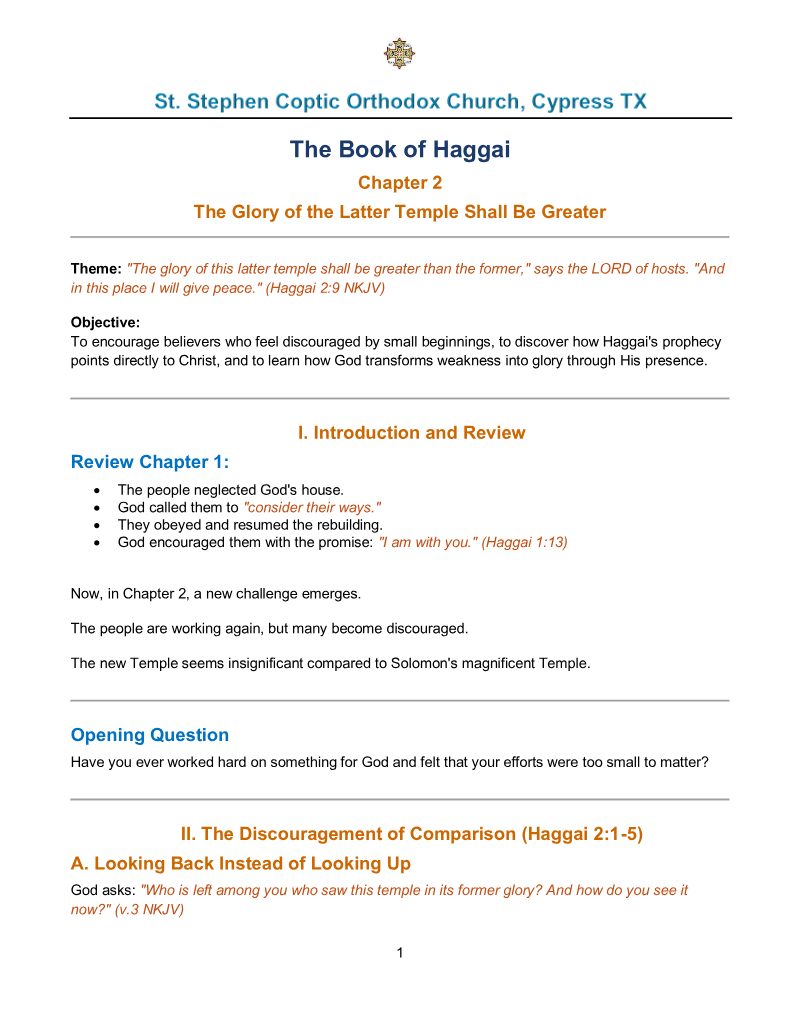
Haggai 2
The Glory of the Latter Temple Shall Be Greater
Part 3
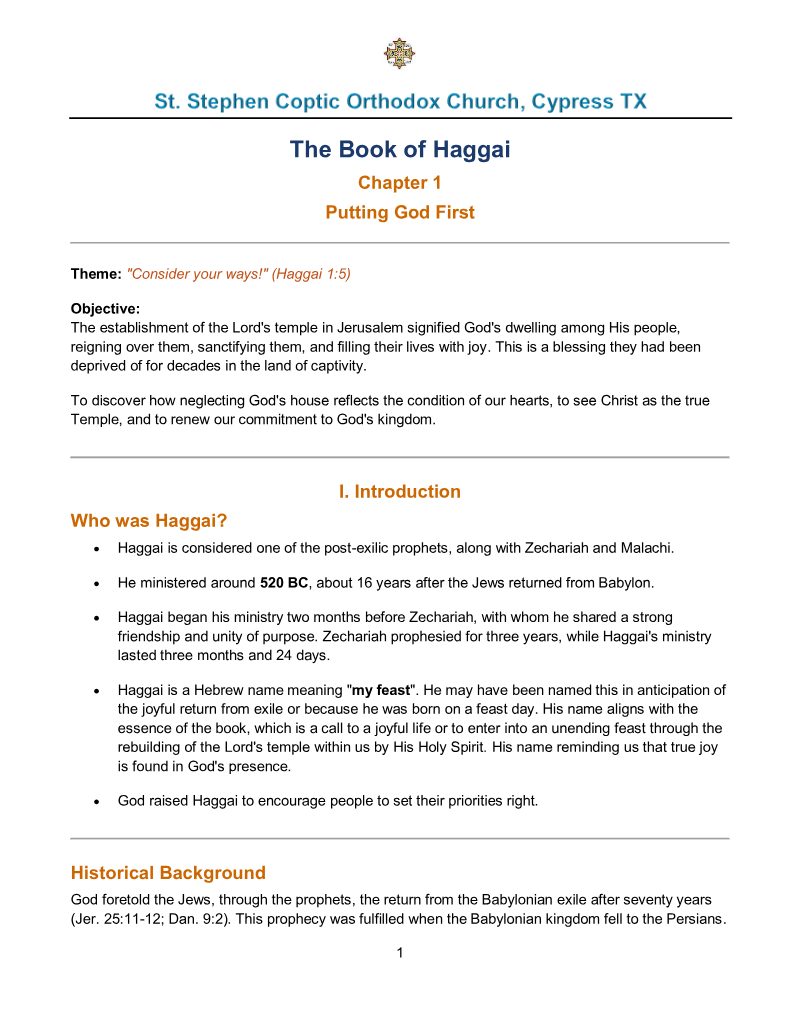
Haggai 1
Putting God First
Part 2
The Minor Prophets series
13 studies so far, newest first. The next part appears here after the next English Bible Study.
See the whole series