
Minor Prophets · Part 2
Haggai 1
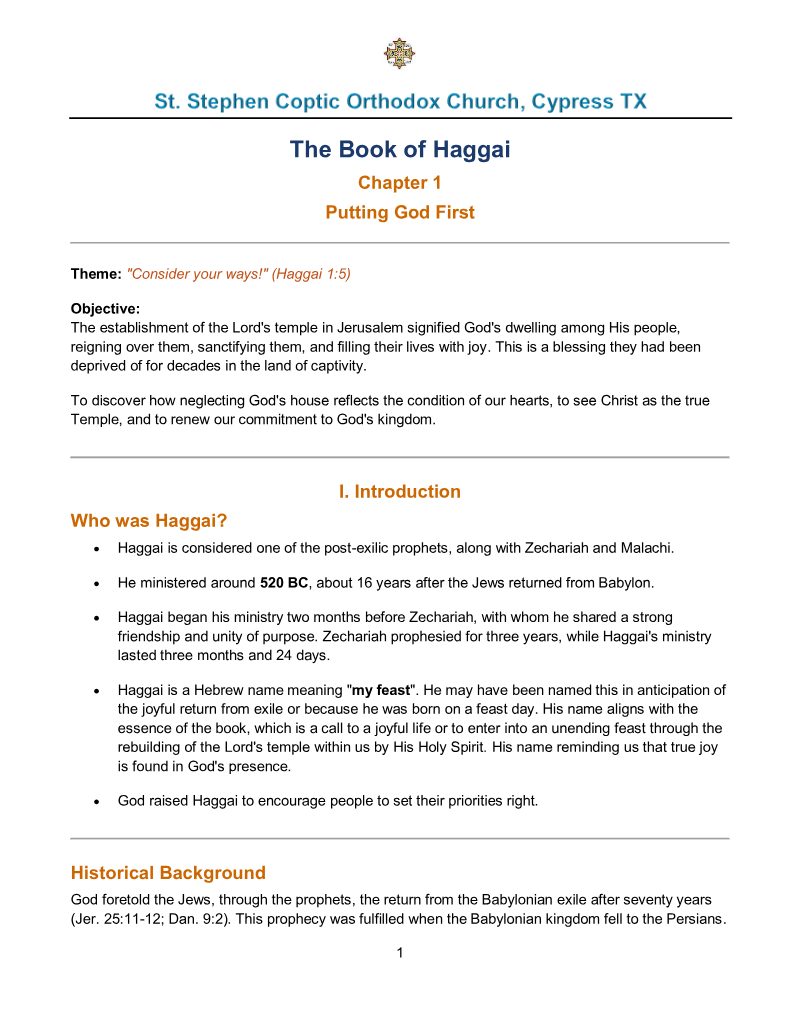
Putting God First
The establishment of the Lord's temple in Jerusalem signified God's dwelling among His people, reigning over them, sanctifying them, and filling their lives with joy. This is a blessing they had been deprived of for decades in the land of captivity.
- Date
- Series
- Minor Prophets
- Theme
- "Consider your ways!" (Haggai 1:5)
On this page
Outline
To discover how neglecting God's house reflects the condition of our hearts, to see Christ as the true Temple, and to renew our commitment to God's kingdom.
I. Introduction
Who was Haggai?
- Haggai is considered one of the post-exilic prophets, along with Zechariah and Malachi.
- He ministered around 520 BC, about 16 years after the Jews returned from Babylon.
- Haggai began his ministry two months before Zechariah, with whom he shared a strong friendship and unity of purpose. Zechariah prophesied for three years, while Haggai's ministry lasted three months and 24 days.
- Haggai is a Hebrew name meaning "my feast". He may have been named this in anticipation of the joyful return from exile or because he was born on a feast day. His name aligns with the essence of the book, which is a call to a joyful life or to enter into an unending feast through the rebuilding of the Lord's temple within us by His Holy Spirit. His name reminding us that true joy is found in God's presence.
- God raised Haggai to encourage people to set their priorities right.
Historical Background
God foretold the Jews, through the prophets, the return from the Babylonian exile after seventy years (Jer. 25:11-12; Dan. 9:2). This prophecy was fulfilled when the Babylonian kingdom fell to the Persians. Cyrus, the king of Persia, allowed Zerubbabel, a descendant of David, to return to Jerusalem to rebuild the temple.
Zerubbabel returned from exile with fifty thousand Jews to rebuild the temple. When Zerubbabel laid the foundation, the Samaritans opposed them, and the work stopped for about 16 years. People’s enthusiasm faded and they became preoccupied with building their own houses, while leaving the Lord's house in ruins.
Instead of building God's house, they focused on careers, houses, security, and personal success.
This book came as a call to everyone to return to the work, as if it were a divine invitation to every soul to regain the joy of salvation in the Lord by enjoying His dwelling within and declaring their heart as a temple for the Lord and their depths as consecrated to Him.
The message is timeless:
God's work is often delayed not by enemies but by misplaced priorities of His own people.
Reflect
If someone looked at your calendar and your bank statement, what would they conclude is most important to you?
II. Summary of the Book of Haggai
This book contains four prophecies delivered by Haggai:
- The first prophecy (Ch. 1): Delivered on the first day of the sixth month in the second year of King Darius, it rebukes the people for leaving the temple in ruins. This prophecy bore fruit as the people were motivated to work.
- The second prophecy (2:1-9): Delivered on the twenty-first day of the seventh month, it encourages the workers to continue without mourning the glory of the old temple, rejecting thoughts that discourage the soul, and announcing the appearance of a new temple with surpassing glory.
- The third prophecy (2:10-19): Delivered on the twenty-fourth day of the ninth month, it serves as an appendix to the previous prophecy. It emphasizes that neglecting God's priority in their lives deprives them of blessings, encouraging them to persevere in their spiritual lives with fervent zeal.
- The fourth prophecy (2:20-23): Delivered on the same day as the previous prophecy, it affirms that the Lord will shake the nations and establish Zerubbabel as His signet ring.
III. Chapter 1
First: The People's Excuse (vv.1–2)
"The time has not come, the time that the LORD'S house should be built."
People often postpone obedience.
They never said: "We don't want God's house."
They simply said: "Not now."
Reflect
- What excuses do we make today for delaying spiritual growth (our inward temple)?
- What good things sometimes replace the best thing?
Patristic Insight
The Fathers repeatedly taught that spiritual negligence eventually affects every area of life.
St. John Chrysostom:
"Nothing makes us poorer than neglecting the things of God while pursuing earthly gain."
Second: "Consider Your Ways" (vv.3–6)
This phrase appears several times. It means: "Set your priority right."
God asks them to evaluate their lives. They experienced:
- much labor
- little harvest
- empty satisfaction
"You eat, but do not have enough."
"And he who earns wages, earns wages to put into a bag with holes."
Reflect
Have you ever worked harder and harder but felt less fulfilled? Why?
Spiritual Principle
Without God, success never satisfies.
This anticipates Christ's words:
"For what profit is it to a man if he gains the whole world, and loses his own soul?"
Patristic Insight
St. Augustine:
"Our hearts are restless until they rest in You."
No earthly achievement can fill the space designed for God.
Third: Haggai 1:12–15
A. The People's Response
Remarkably, they obeyed.
"The people feared the presence of the LORD."
Revival begins with obedience. Not only emotions, not only excitement, obedience.
B. God's Encouragement
"I am with you, says the LORD."
This is one of the great covenant promises. Whenever God calls His people to difficult work, He accompanies them.
Connection with Christ
Jesus ends His earthly ministry saying:
"And lo, I am with you always, even to the end of the age."
The promise given through Haggai reaches its fullness in Christ.
Patristic Insight
St. Cyril of Alexandria:
"The presence of God is the greatest blessing, for where God dwells, every good thing flourishes."
IV. Christ in Haggai
Although Haggai speaks about rebuilding the physical Temple in Jerusalem, the prophecy ultimately points to Christ.
1. Christ is the True Temple
Jesus said:
"Destroy this temple, and in three days I will raise it up."
He spoke of His body.
The physical Temple was only a shadow.
Christ is God's dwelling among humanity.
2. The Church is Christ's Temple
After Pentecost, believers become "the temple of the Holy Spirit."
Haggai's call to rebuild becomes our call to build the Church through evangelism, discipleship, and holiness.
3. Christ Must Have First Place
The people built their own houses while neglecting God's house.
Christ teaches:
"Seek first the kingdom of God and His righteousness."
The message of Haggai reaches its fulfillment in Christ.
V. Practical Applications
1. Examine Your Priorities
Ask yourself:
- What occupies most of my thoughts?
- What receives my best energy?
- What have I postponed spiritually?
- What "paneled house" competes with God's priorities in your life?
God still says: "Consider your ways."
2. Build God's Kingdom First
This includes:
- regular prayer
- Bible reading
- serving the Church
- evangelism
- caring for the poor
- discipleship
Building God's house today means building His people.
3. Don't Wait for a Better Time
The people waited sixteen years.
Delayed obedience is still disobedience.
Today is the day to begin.
4. God's Work Brings God's Presence
The greatest reward for obedience is not success.
It is God's promise: "I am with you."
Key Verse to Memorize
"Thus says the LORD of hosts: 'Consider your ways!”
VI. Closing Reflection
Haggai's message is not merely about constructing a building but about restoring right worship and reordered hearts. The unfinished Temple reflected an unfinished devotion to God. In Christ, the true Temple has come, and through His Spirit believers become living stones in God's spiritual house. The call of Haggai remains urgent today: put God first, rebuild what has been neglected, and trust His promise, "I am with you."
7 pages in the handout
Minor Prophets
More in this series
Haggai 2
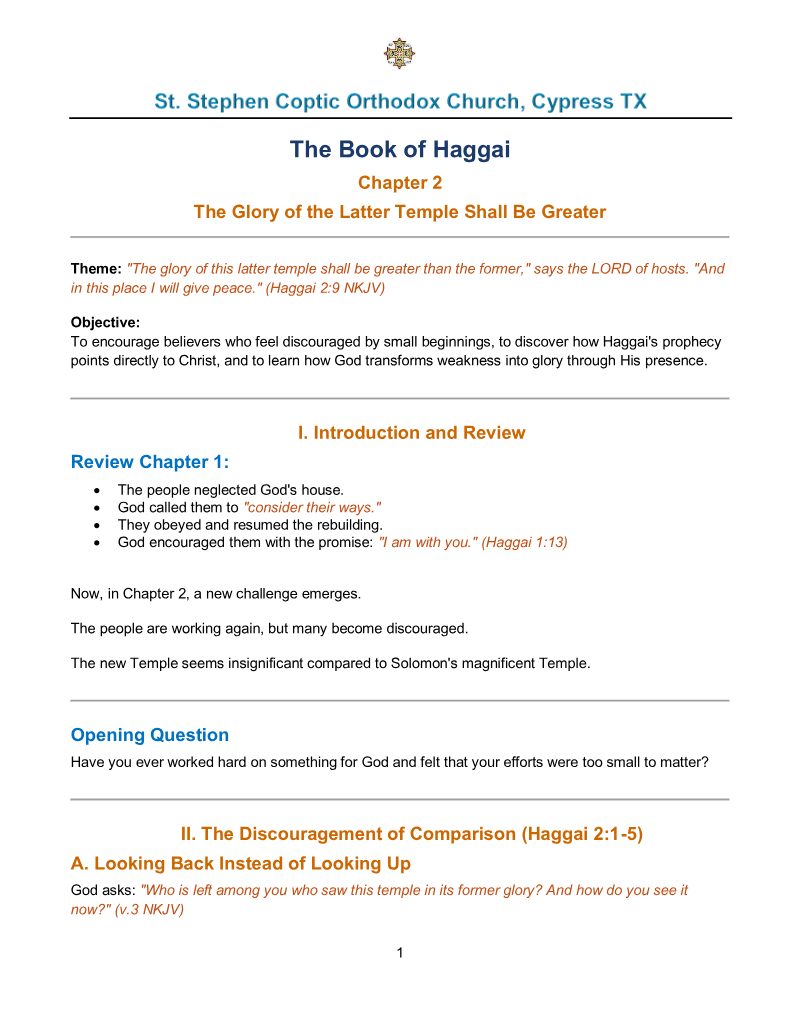
The Glory of the Latter Temple Shall Be Greater
Part 3
Malachi 4
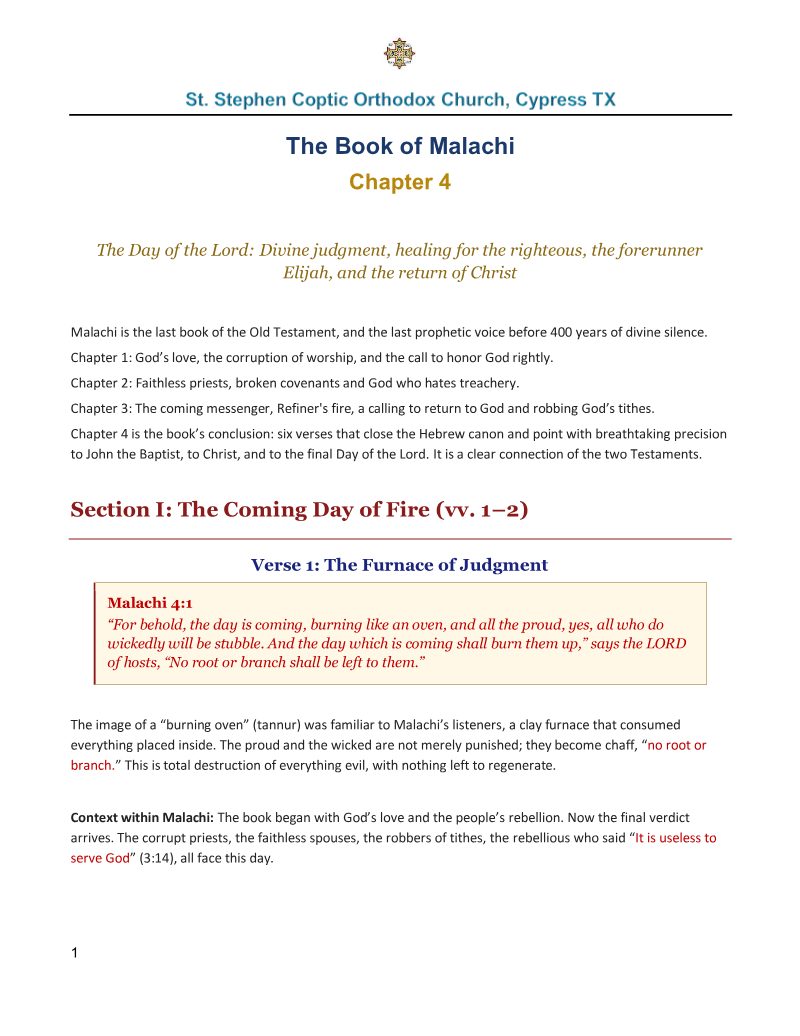
The Day of the Lord: Divine judgment, healing for the righteous, the forerunner Elijah, and the return of Christ
Part 1 · Previous
The Minor Prophets series
13 studies so far, newest first. The next part appears here after the next English Bible Study.
See the whole series