
Minor Prophets · Part 4
Zechariah 1
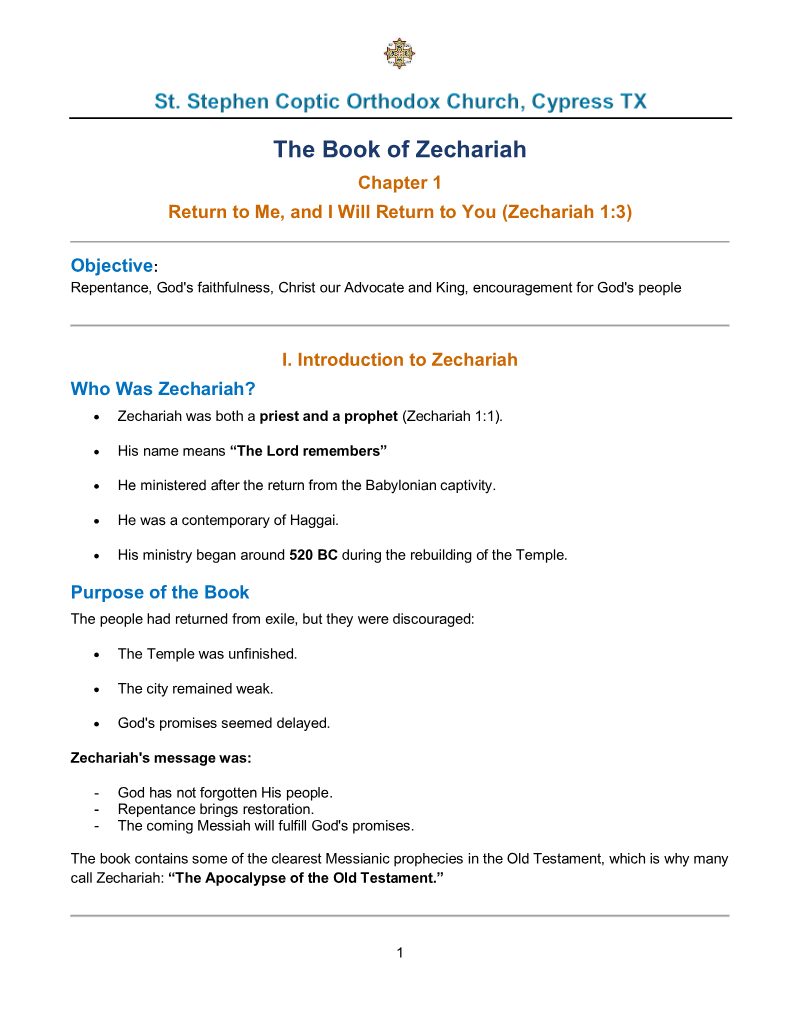
Return to Me, and I Will Return to You (Zechariah 1:3)
Repentance, God's faithfulness, Christ our Advocate and King, encouragement for God's people
- Date
- Series
- Minor Prophets
On this page
Outline
I. Introduction to Zechariah
Who Was Zechariah?
- Zechariah was both a priest and a prophet (Zechariah 1:1).
- His name means “The Lord remembers”
- He ministered after the return from the Babylonian captivity.
- He was a contemporary of Haggai.
- His ministry began around 520 BC during the rebuilding of the Temple.
Purpose of the Book
The people had returned from exile, but they were discouraged:
- The Temple was unfinished.
- The city remained weak.
- God's promises seemed delayed.
Zechariah's message was:
- God has not forgotten His people.
- Repentance brings restoration.
- The coming Messiah will fulfill God's promises.
The book contains some of the clearest Messianic prophecies in the Old Testament, which is why many call Zechariah: “The Apocalypse of the Old Testament.”
II. Historical Background
The exile had occurred because Israel repeatedly rejected God's warnings.
God now sends Zechariah to tell the people: "Do not repeat the mistakes of your fathers."
The rebuilding of the Temple was not merely a construction project; it was a sign of renewed fellowship with God.
III. The Call to Repentance (Zechariah 1:1–6)
Zechariah 1:3 "Return to Me," says the LORD of hosts, "and I will return to you."
Reflect
Why does God begin His message with repentance rather than comfort?
Key Truth
Revival always begins with repentance.
God's people wanted blessings, but God first wanted their hearts.
Notice:
God does not say, "Build first."
He says, "Return to Me first."
St. John Chrysostom:
"God never turns away from us first. We depart from Him, and when we return, we discover that He was waiting for us."
St. Augustine:
"The Lord commands us to return because He desires to restore what sin has damaged."
Verse 4: "Do not be like your fathers..."
Israel's history became a warning.
The previous generation:
- Heard the prophets.
- Ignored the prophets.
- Experienced judgment.
Reflect
What are some spiritual mistakes I repeatedly make today?
Possible answers:
- Neglecting prayer.
- Delaying repentance.
- Trusting material success more than God.
- Becoming comfortable in spiritual life.
- Not forgiving others.
- Judging others.
Practical Application
Ask and return:
- Is there an area where I need to return to God?
- What spiritual habits have I neglected?
- Am I merely active in church or truly close to Christ?
IV. First Vision: The Man Among the Myrtle Trees (Zechariah 1:7–12)
The First Vision
Zechariah sees:
- A man riding a red horse.
- Horses of different colors behind him.
- Myrtle trees in a valley.
Verse 11: "We have walked to and fro throughout the earth, and behold, all the earth is resting quietly."
At first glance, the nations appear secure while Jerusalem remains afflicted.
This troubled God's people.
Verse 12: "Then the Angel of the LORD answered and said, 'O LORD of hosts, how long will You not have mercy on Jerusalem?”
The Angel intercedes for God's people.
Christ in Zechariah 1
Many Church Fathers and Christian interpreters see the Man Among the Myrtle Trees as a manifestation of Christ before His incarnation.
This is one of the beautiful pictures of Christ in the chapter.
Jesus is:
- Present among His people.
- Aware of their suffering.
- Interceding for them.
Just as Christ stands among the myrtle trees, He walks among His Church.
Compare:
Revelation 1:13: "One like the Son of Man" walking among the lampstands.
Hebrews 7:25: "He always lives to make intercession for them."
St. Cyril of Alexandria: taught that Christ is the true Mediator who stands between God and humanity and presents our needs before the Father.
St. Athanasius: wrote that the Son continually cares for those whom He has redeemed and does not abandon His people."
Why Myrtle Trees?
The myrtle is a humble shrub growing in low places.

Myrtle trees are multi-purpose, climate-resilient plants that combine ornamental beauty, fragrance, edible fruits, and traditional uses. Myrtle has been associated with love, beauty, purity, and loyalty since ancient time. It is often included in wedding bouquets and has a long history in traditional medicine, and culinary traditions across the Mediterranean.
Many commentators see it as a picture of God's humble, yet beautiful people.
The Messiah stands among them, not above them.
Application
When discouraged:
- Christ sees.
- Christ knows.
- Christ intercedes.
- Christ remains present among us.
How does knowing that Christ intercedes for us change the way we face trials?
V. God's Jealous Love for His People (Zechariah 1:13–17)
Verse 14: "I am zealous for Jerusalem and for Zion with great zeal."
The word "zealous" speaks of covenant love. God is not indifferent toward His people.
Verse 16: "I am returning to Jerusalem with mercy."
The people had returned from Babylon. Now God says: "I am returning to Jerusalem."
This is restoration and renewed covenant.
Christ Connection
In Christ, God fully comes to dwell among His people.
John 1:14: "And the Word became flesh and dwelt among us."
The return of God's presence ultimately points to the Incarnation.
Practical Application
Many believers think: "God must be tired of me."
Zechariah teaches the opposite; God's desire is restoration. Repentance is met with mercy.
VI. Second Vision: The Four Horns and Four Craftsmen (Zechariah 1:18–21) The Second Vision
+ Four Horns: Represent powers and nations that oppressed God's people.
In Scripture, horns often symbolize strength and power.
- Four Craftsmen: God raises craftsmen to destroy the horns.
- Main Lesson: No enemy is stronger than God's purposes.
The oppressors seemed invincible, but God says, "I already have the tools prepared."
Christ in This Vision
Ultimately, Christ is the One who defeats every enemy:
- Sin
- Death
- Satan
- Every worldly power opposed to God
Colossians 2:15: "Having disarmed principalities and powers, He made a public spectacle of them."
St. Irenaeus: taught that Christ overturned the tyranny of the enemy through His Cross and Resurrection.
Application
Believers often focus on the size of the problem / Enemy "horn." God focuses on the "craftsman."
Our problems never exceed God's resources.
What "horns" seem intimidating in our lives today?
Examples:
- Fear
- Illness
- Financial struggles
- Family conflicts
- Spiritual warfare
How has God previously shown Himself stronger than these obstacles?
Conclusion: Major Lessons from Zechariah 1
1. God Calls Us to Return
"Return to Me, and I will return to you."
Repentance is the doorway to revival.
2. Christ Stands Among His People
The Angel of the Lord points us to Christ, our Intercessor.
3. God Has Not Forgotten
The name Zechariah means: "The Lord remembers."
God remembers His promises.
4. God's Mercy Is Greater Than Our Failures
Judgment is not God's final word, Mercy is.
5. Every Enemy Has a Limit
God always has His craftsmen prepared.
Closing Reflection Questions on Chapter 1
- In what area is God calling me to return to Him?
- What discouragement am I carrying that needs to be surrendered to God?
- Which promise of God do I need to trust more fully?
- How can I encourage others who feel forgotten or discouraged?
Closing Prayer
Heavenly Father, we thank You for speaking through Your prophet Zechariah. Help us not to repeat the mistakes of those who ignored Your voice. Give us hearts that quickly return to You in repentance.
Thank You for sending Christ, our Intercessor and King, who stands among His people and continually interceed for us. Strengthen us when we are discouraged, remind us of Your faithfulness, and help us trust that no enemy is greater than Your power. In Jesus Christ our Lord, to whom belongs glory with the Father and the Holy Spirit, now and forever. Amen.
8 pages in the handout
Minor Prophets
More in this series
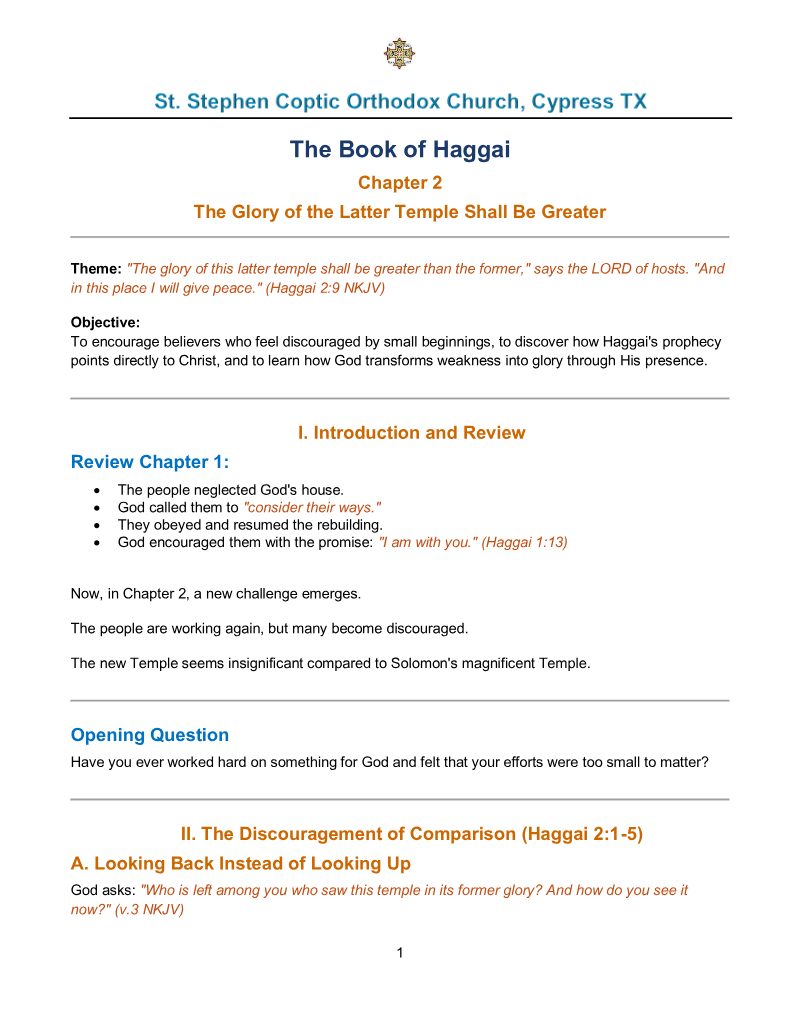
Haggai 2
The Glory of the Latter Temple Shall Be Greater
Part 3 · Previous
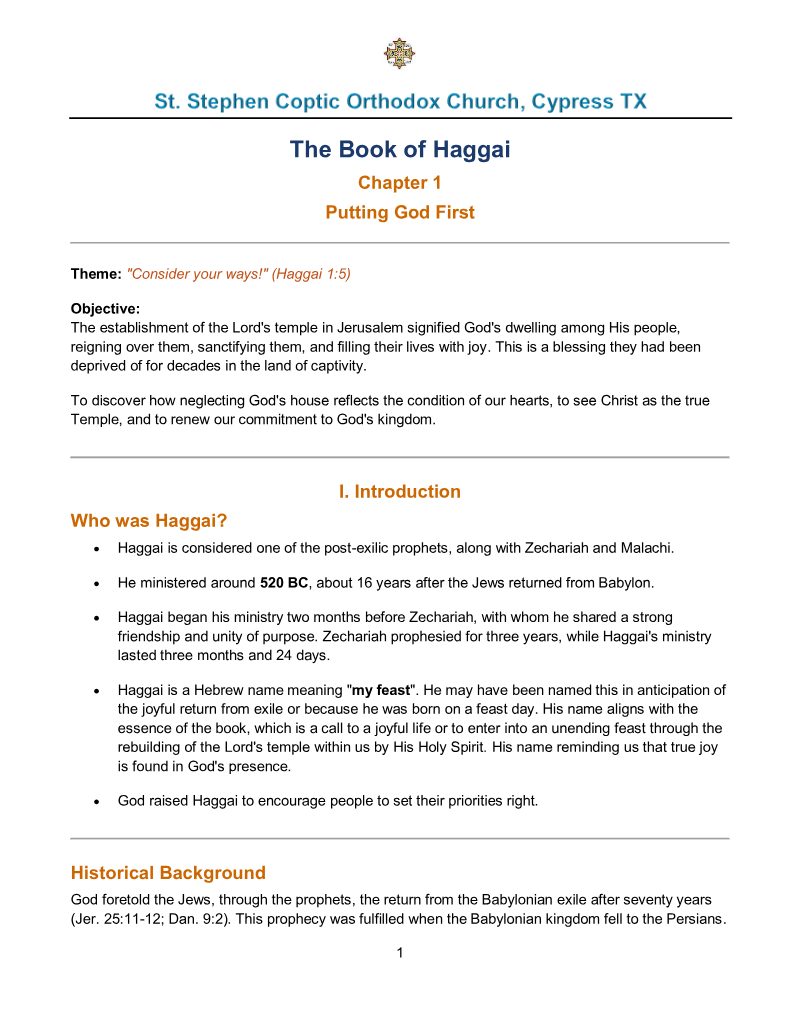
Haggai 1
Putting God First
Part 2
The Minor Prophets series
13 studies so far, newest first. The next part appears here after the next English Bible Study.
See the whole series