
Minor Prophets · Part 6
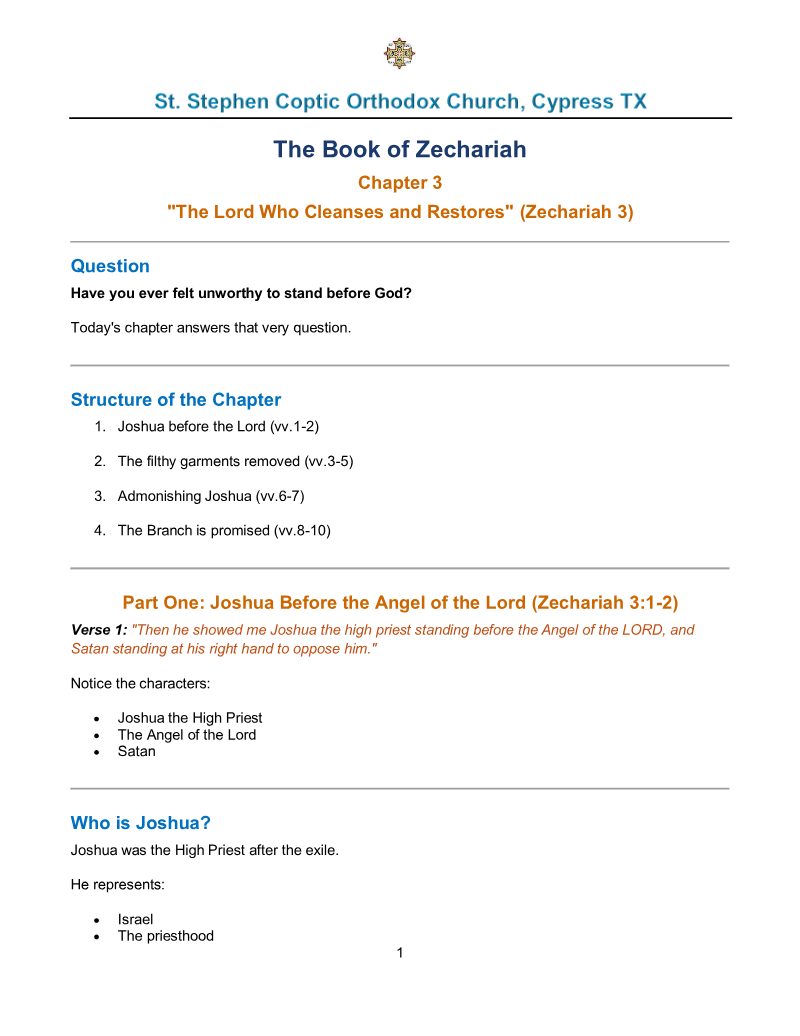
Zechariah 3
"The Lord Who Cleanses and Restores" (Zechariah 3)
- Date
- Series
- Minor Prophets
On this page
Outline
Reflect
Have you ever felt unworthy to stand before God?
Today's chapter answers that very question.
Structure of the Chapter
- Joshua before the Lord (vv.1-2)
- The filthy garments removed (vv.3-5)
- Admonishing Joshua (vv.6-7)
- The Branch is promised (vv.8-10)
Part One: Joshua Before the Angel of the Lord (Zechariah 3:1-2)
Verse 1: "Then he showed me Joshua the high priest standing before the Angel of the LORD, and Satan standing at his right hand to oppose him."
Notice the characters:
- Joshua the High Priest
- The Angel of the Lord
- Satan
Who is Joshua?
Joshua was the High Priest after the exile.
He represents:
- Israel
- The priesthood
- Every believer who comes before God
Who is Satan?
The Hebrew word means:
The Accuser.
Revelation 12:10 calls him: "The accuser of our brethren."
His work is always accusation.
He reminds us of:
- failures
- sins
- weaknesses
The Angel of the Lord
Many Church Fathers understood the Angel of the Lord here to be the pre-incarnate Christ.
Notice: The Angel speaks with divine authority and He rebukes Satan. Only God can do that.
Verse 2: "The LORD rebuke you, Satan!"
Christ becomes Joshua's Advocate.
Exactly as: 1 John 2:1 "We have an Advocate with the Father, Jesus Christ the righteous."
St. Cyril of Alexandria:
"The devil accuses, but Christ justifies. The Judge Himself becomes the Defender of mankind."
Origen:
"Joshua represents all who have returned to God after captivity."
Babylon symbolizes the world. Every Christian has returned from Babylon.
Reflect
- When does Satan usually accuse us?
- How does Christ answer those accusations?
Christ in This Passage
Joshua never defends himself but Christ defends him.
Exactly as Romans 8:33-34 says; “Who shall bring a charge against God’s elect? It is God who justifies. Who is he who condemns? It is Christ who died, and furthermore is also risen, who is even at the right hand of God, who also makes intercession for us.”
Part Two: The Filthy Garments (Zechariah 3:3-5)
Joshua stands wearing filthy garments.
The Hebrew expression means garments stained beyond cleansing.
These represent sin and uncleanness.
Isaiah says: "All our righteousnesses are like filthy rags." (Is 64: 6)
Notice something remarkable.
God never says: "Joshua, clean yourself first."
Instead He says: "Take away the filthy garments."
Salvation is God's work.
Verse 4: "See, I have removed your iniquity from you, and I will clothe you with rich robes."
This is a very clear statement describing salvation. The parable of the Prodigal son.
The Clean Turban in Verse 5 represents:
- restored priesthood
- renewed mind
- holiness
Practical Lesson
God doesn't merely forgive, He restores.
Many people believe: "I can never serve God again." Joshua proves otherwise.
Reflect
Have you ever allowed guilt to stop you from serving God?
Part Three: God's Commands (Verses 6-7)
Grace always comes before responsibility.
Notice the order; first God cleanses then He commissions.
Never the reverse.
God tells Joshua; Walk in My ways and keep My command.
Then; you shall judge My house.
The Christian life follows the same pattern.
Called to be saved by grace, then called to obedience and work according to the calling …
St. Irenaeus:
"God restores man that he may again serve in holiness."
Practical Application
Holiness is not the price of salvation, it is the fruit of salvation.
Part Four: The Coming Branch (Verses 8-10)
Here the prophecy suddenly looks beyond Joshua.
Verse 8: "For behold, I am bringing forth My Servant the BRANCH."
One of the greatest Messianic titles. The Branch appears in Isaiah, Jeremiah and Zechariah
Christ the Branch
Why "Branch"?
Because He grows from David's family after it appears cut down.
Isaiah 11: "There shall come forth a Rod from the stem of Jesse."
St. Jerome:
"The Branch is Christ, springing from the root of David."
St. Cyril of Jerusalem:
"The prophets called Him Branch because He would blossom from the Virgin."
The Stone
Verse 9: "Upon the stone are seven eyes."
The stone symbolizes Christ.
Psalm 118
Isaiah 28
Matthew 21
1 Peter 2
Christ is: The Cornerstone.
The seven eyes symbolize:
Perfect wisdom.
Perfect knowledge.
Nothing escapes Christ.
One Day
Verse 9: "I will remove the iniquity of that land in one day."
What day?
Friday; on one Friday afternoon,
Jesus removed the sin of the world.
Verse 10: Everyone sits under vine and fig tree.
Picture of peace, security and Kingdom blessing, fulfilled ultimately in Christ.
Christ Throughout Zechariah 3
Christ is:
- The Angel of the Lord
- Our Advocate
- The One who rebukes Satan
- The One who removes sin
- The One who clothes us
- The Branch
- The Stone
Every section point to Jesus.
Practical Applications
1. Stop Listening to the Accuser
Satan reminds us of sins.
Christ reminds us of forgiveness of sins that is offered through repentance and Communion.
2. Accept God's Forgiveness
Many Christians believe in God’s forgiveness, but they don’t get it.
We see in Joshua’s case that God restores broken servants, when they come before Him.
3. Live Worthy of Your New Garments
Ephesians 4:24: "Put on the new man..."
Wear the robes Christ has given.
4. Keep Your Eyes on Christ
Everything in Zechariah points toward Him.
5. Serve After Restoration
Failure is not the end.
Peter denied Christ.
David fell.
Joshua stood filthy.
Yet God restored them.
Illustration
A famous story is told of a judge who adopted a young orphan after the child had repeatedly appeared before him in court. One day, someone reminded the now-grown son of his troubled past. The son replied, "Yes, I remember where I came from, but I also remember whose son I am now."
That is the Christian life. Satan points to our past, but Christ points to our new identity. We no longer stand before God clothed in our own stained garments but in the righteousness of Christ.
Memory Verse
Zechariah 3:4 (NKJV) "See, I have removed your iniquity from you, and I will clothe you with rich robes."
Conclusion
Zechariah 3 is one of the clearest Old Testament portraits of the gospel. We see humanity represented by Joshua; guilty, unable to cleanse itself, and accused by Satan. Yet we also see the gracious work of God in Christ, who silences the accuser, removes our iniquity, clothes us with righteousness, and restores us to joyful service. The chapter reaches its climax in the promise of the Branch, fulfilled in Jesus Christ, through whom God removed sin "in one day" on the Cross.
As Christians, we are invited to live each day not under the weight of accusation, but in repentance, freedom, holiness, and hope that come from being clothed in Christ's righteousness.
8 pages in the handout
Minor Prophets
More in this series
Zechariah 2
"The Lord Will Dwell in the Midst of You" (Zechariah 2)
Part 5 · Previous
Zechariah 1
Return to Me, and I Will Return to You (Zechariah 1:3)
Part 4
The Minor Prophets series
13 studies so far, newest first. The next part appears here after the next English Bible Study.
See the whole series