
Minor Prophets · Part 10
Zechariah 8
God Returns to His People
- Date
- Series
- Minor Prophets
- Theme
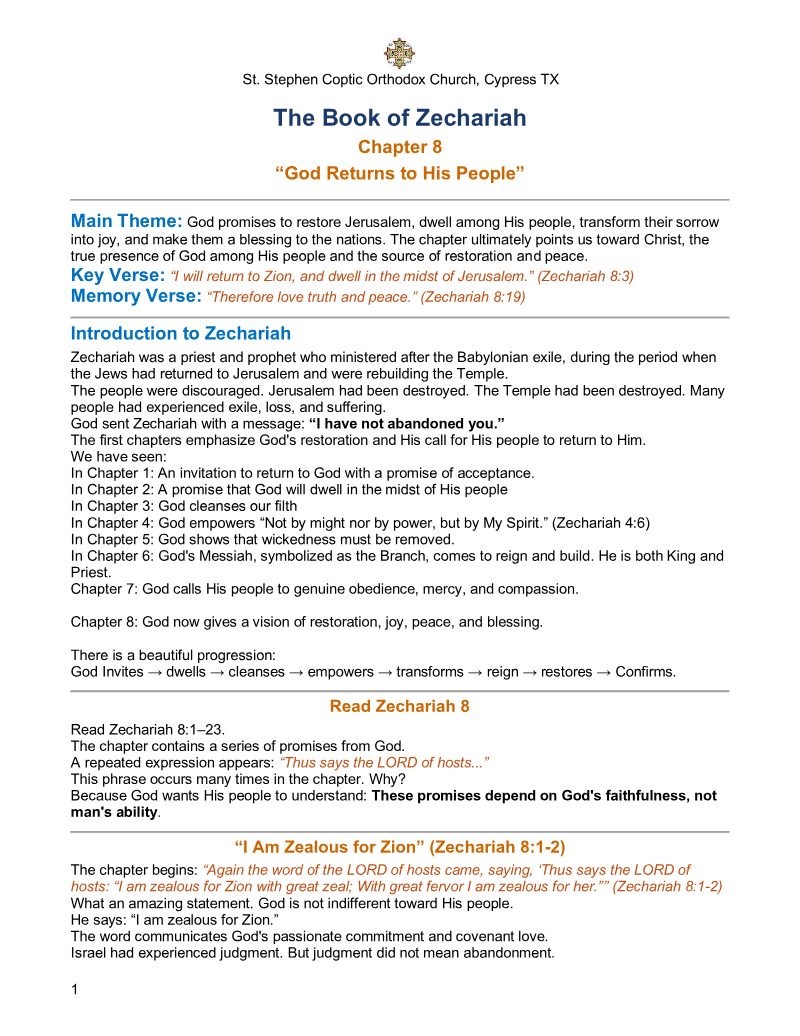
- God promises to restore Jerusalem, dwell among His people, transform their sorrow into joy, and make them a blessing to the nations. The chapter ultimately points us toward Christ, the true presence of God among His people and the source of restoration and peace.
Key verse
“I will return to Zion, and dwell in the midst of Jerusalem.”
Memory verse
“Therefore love truth and peace.”
On this page
Outline
Introduction to Zechariah
Zechariah was a priest and prophet who ministered after the Babylonian exile, during the period when the Jews had returned to Jerusalem and were rebuilding the Temple.
The people were discouraged. Jerusalem had been destroyed. The Temple had been destroyed. Many people had experienced exile, loss, and suffering.
God sent Zechariah with a message: “I have not abandoned you.”
The first chapters emphasize God's restoration and His call for His people to return to Him.
We have seen:
In Chapter 1: An invitation to return to God with a promise of acceptance.
In Chapter 2: A promise that God will dwell in the midst of His people
In Chapter 3: God cleanses our filth
In Chapter 4: God empowers “Not by might nor by power, but by My Spirit.” (Zechariah 4:6)
In Chapter 5: God shows that wickedness must be removed.
In Chapter 6: God's Messiah, symbolized as the Branch, comes to reign and build. He is both King and Priest.
Chapter 7: God calls His people to genuine obedience, mercy, and compassion.
Chapter 8: God now gives a vision of restoration, joy, peace, and blessing.
There is a beautiful progression:
God Invites → dwells → cleanses → empowers → transforms → reign → restores → Confirms.
Read Zechariah 8
Read Zechariah 8:1–23.
The chapter contains a series of promises from God.
A repeated expression appears: “Thus says the LORD of hosts...”
This phrase occurs many times in the chapter. Why?
Because God wants His people to understand: These promises depend on God's faithfulness, not man's ability.
“I Am Zealous for Zion”
The chapter begins: “Again the word of the LORD of hosts came, saying, ‘Thus says the LORD of hosts: “I am zealous for Zion with great zeal; With great fervor I am zealous for her.”” (Zechariah 8:1-2) What an amazing statement. God is not indifferent toward His people.
He says: “I am zealous for Zion.”
The word communicates God's passionate commitment and covenant love.
Israel had experienced judgment. But judgment did not mean abandonment.
God disciplines His children, but He does not stop loving them.
This is an important distinction.
Sometimes when we go through difficulties, we think: “God must have forgotten me.”
Zechariah says: God can be working even when we cannot see His work.
“I Will Return to Zion”
God says: “I will return to Zion, and dwell in the midst of Jerusalem.” (Zechariah 8:3)
This is the central promise of the chapter.
God's greatest gift is not: prosperity, buildings, peace, success, security.
God's greatest gift is His presence.
The people had lost their Temple.
But God's promise is: “I will dwell in your midst.”
This is the heart of biblical restoration.
Christ; God Dwelling Among Us
This promise points beautifully toward Christ.
John 1:14 says: “And the Word became flesh and dwelt among us.”
What Zechariah anticipated becomes reality in Christ: God comes to dwell among His people.
In the Old Testament: God's presence was associated with the Temple.
In Christ: God comes personally among humanity.
Jesus says: “He who has seen Me has seen the Father.” (John 14:9)
The Ultimate Restoration Is God's Presence
This gives us a different understanding of restoration.
Sometimes we pray: “Lord, restore my situation.”
God may answer.
But sometimes God's deeper answer is: “I will restore you by bringing you closer to Me.”
The greatest restoration isn't necessarily getting back what we lost. It is finding God in the middle of what we have lost.
Jerusalem Will Become a City of Truth
God says: “.. Jerusalem shall be called the City of Truth…” (Zechariah 8:3)
This connects directly with Chapter 7.
Chapter 7 condemned dishonesty, injustice, hardness of heart, and oppression.
Chapter 8 describes the restored community: Truth replaces falsehood.
This is important.
God's restoration is not merely physical. He changes the character of His people.
“The Mountain of the LORD of Hosts”
God says Jerusalem will become: “The Mountain of the LORD of hosts, The Holy Mountain.”
This prophecy goes beyond the immediate post-exilic community.
Isaiah prophesied: “Many peoples shall come and say, ‘Come, and let us go up to the mountain of the LORD.’” (Isaiah 2:3)
That means; God's salvation will reach beyond Jerusalem. This prepares us for the universal mission of Christ and His Church.
Old Men and Women Sitting in the Streets (Zechariah 8:4)
God says: “Old men and old women shall again sit in the streets of Jerusalem, each one with his staff in his hand because of great age.”
This is an expression of security and peace.
In a city experiencing war, elderly people would not safely sit outside.
But God says: There will be such peace that the elderly can sit peacefully in the streets.
This is what restoration looks like. Not simply buildings. People feeling safe enough to live normally again.
Children Playing in the Streets (Zechariah 8:5)
Then God says: “The streets of the city shall be full of boys and girls playing in its streets.”
Imagine the picture; Children are running, families are living, the elderly are safe, and The city is alive. This is the opposite of a destroyed city.
God's restoration brings life.
A Practical Application for Families
One of the clearest ways to evaluate a healthy Christian home is to ask: What atmosphere are we creating for our children?
Do they experience: fear?, constant criticism?, anger?, tension?,
Or: peace?, love?, prayer?, joy?, security?,
The Christian home should be a small picture of the kingdom of God.
A child should learn something about God by experiencing God's love through his family.
“If It Is Marvelous in the Eyes of This People...”
God asks: “If it is marvelous in the eyes of this remnant of this people in these days, will it also be marvelous in My eyes?”
The people may look at their situation and think: “This is impossible.”
Jerusalem was devastated, the Temple was still being rebuilt, and the future looked uncertain.
God's response: “What looks impossible to you is not impossible to Me.”
This echoes the angel's words to Mary: “For with God nothing will be impossible.” (Luke 1:37)
“I Will Save My People”
God says: “Surely I will save My people from the land of the east and from the land of the west.”
God promises to gather His scattered people.
God promises: I will bring them home.
This becomes a powerful biblical image of salvation.
Sin scatters, God gathers.
Sin separates, God reconciles.
Sin creates exile, Christ brings us home.
“They Shall Be My People”
God says: “They shall be My people And I will be their God, In truth and righteousness.”
This is covenant language.
The relationship is restored: They are His people and He is their God.
This is ultimately what salvation is about.
Not merely: “God gives me blessings.”
But: “I belong to God, and God belongs to me.”
Christ and the New Covenant
Through Christ, this promise reaches its fulfillment.
Peter tells Christians: “You are a chosen generation, a royal priesthood, a holy nation, His own special people.” (1 Peter 2:9)
The Church is now described as God's people.
Paul says: “I will dwell in them And walk among them. I will be their God, And they shall be My people.” (2 Corinthians 6:16)
The promise of Zechariah becomes part of the New Covenant reality.
“Let Your Hands Be Strong”
God tells the people: “Let your hands be strong, You who have been hearing in these days These words by the mouth of the prophets.”
Why does God tell them: “Be strong”?
Because they had become discouraged, they were rebuilding, and they had opposition and They had experienced failure.
God tells them: Keep building.
This connects directly to Chapter 4: “Not by might nor by power, but by My Spirit.”
God's promise should produce courage, not passivity.
A Word for Servants
Sometimes servants become discouraged because: attendance is low, people don't respond, ministry is difficult, people leave, problems arise, servants disagree, or results are slow.
God says: “Let your hands be strong.”
Don't measure faithfulness only by visible results.
Your responsibility is faithfulness.
God is responsible for the fruit.
Paul says: “I planted, Apollos watered, but God gave the increase.” (1 Corinthians 3:6)
God Turns the Curse Into Blessing (Zechariah 8:10-13)
The people had experienced hardship.
Verse 10 describes a time when there was: no peace, no prosperity, difficulty in work, and fear from enemies.
But God says: “But now I will not treat the remnant of this people as in the former days.”
And then: “For the seed shall be prosperous, The vine shall give its fruit, The ground shall give her increase, And the heavens shall give their dew.” (Zechariah 8:12)
God promises transformation.
Then comes a remarkable statement: “You were a curse among the nations, O house of Judah and house of Israel; So I will save you, and you shall be a blessing.” (Zechariah 8:13)
“You Shall Be a Blessing”
This is one of the most important phrases in the chapter.
God doesn't save His people merely from something.
He saves them for something.
Saved → Blessed → Blessing.
God told Abraham: “I will bless you, And make your name great; And you shall be a blessing.” (Genesis 12:2)
God's people are blessed so they can become a blessing.
Christ: The Ultimate Blessing
This finds its ultimate fulfillment in Christ.
Through Christ, the blessing promised to Abraham extends to all nations.
Paul says: “In you all the nations shall be blessed.” (Galatians 3:8)
And: “Christ has redeemed us from the curse of the law...” (Galatians 3:13)
Therefore: Christ takes the curse and gives the blessing.
The Cross is the ultimate example.
He takes: our sin, our curse, and our judgment, and gives us: forgiveness, righteousness, adoption, life, and blessing.
“Do Not Be Afraid”
God ends verse 13: “Do not fear; Let your hands be strong.”
This is a repeated biblical pattern.
God doesn't merely say: “Don't be afraid.”
He gives a reason. Because I am with you. Fear looks at circumstances. Faith looks at God's promises.
“As I Determined to Punish You...”
God reminds them: “Just as I was determined to punish you... so again in these days I am determined to do good to Jerusalem.”
Notice the phrase: “I am determined to do good.”
What a beautiful description of God's heart. God is not looking for opportunities to destroy His children. He desires restoration.
Jeremiah 29:11 expresses a similar principle: “For I know the thoughts that I think toward you... thoughts of peace and not of evil.”
But Restoration Requires a Changed Life (Zechariah 8:16-17)
God then says: “These are the things you shall do: Speak each man the truth to his neighbor; Give judgment in your gates for truth, justice, and peace.”
And: “Let none of you think evil in your heart against your neighbor.”
Notice the connection with Chapter 7.
Chapter 7: Don't oppress, show mercy, show compassion, listen to God.
Chapter 8: Speak truth, practice justice, pursue peace, don't harbor evil, God's restoration produces transformed behavior.
Christianity Is Not Just About Receiving
A common spiritual mistake is: “God bless me.”
But God's plan is: God blesses me → God changes me → God uses me to bless others.
If I receive God's grace but never become gracious... Something is wrong.
If I receive God's forgiveness but never forgive... Something is wrong.
If I receive God's mercy but never show mercy... Something is wrong.
If I receive God's love but never love others... Something is wrong.
The Fasts Become Feasts (Zechariah 8:18-19)
God says: “The fast of the fourth month, the fast of the fifth, the fast of the seventh, and the fast of the tenth shall become joy and gladness and cheerful feasts.”
This is a beautiful reversal.
Fasting → Feasting.
Mourning → Joy.
Sorrow → Gladness.
Judgment → Restoration.
God transforms their history.
God Doesn't Waste Our Pain
This doesn't mean that every painful experience disappears.
But God can take painful chapters of our lives and use them for His glory.
Joseph could say to his brothers: “You meant evil against me; but God meant it for good.” (Genesis 50:20)
The Cross itself demonstrates this.
The greatest evil humanity committed became the place of the greatest salvation.
God can transform wounds into testimonies.
“Love Truth and Peace”
The verse ends: “Therefore love truth and peace.”
Not simply: “Know truth.”
Not simply: “Speak truth.”
Love truth.
And: Love peace.
A Christian should become someone who loves truth, righteousness, reconciliation, peace.
Jesus says: “Blessed are the peacemakers.” (Matthew 5:9)
The Nations Will Come (Zechariah 8:20-23)
The final section is one of the most beautiful parts of the chapter.
God says: “Peoples shall yet come, Inhabitants of many cities.”
And: “Many peoples shall come, And strong nations Shall come to seek the LORD of hosts in Jerusalem.”
Then: “Ten men from every language of the nations shall grasp the sleeve of a Jewish man, saying, ‘Let us go with you, for we have heard that God is with you.’” (Zechariah 8:23)
This is extraordinary.
“God Is With You”
Why do the nations come?
Not because Israel has political power.
Not because Jerusalem is wealthy.
Not because the people have a great army.
They come because:
“We have heard that God is with you.”
This should be the testimony of the Church.
People should be able to look at Christians and say: “God is with you.” Not: “You have the best organization.”
Not: “You have the biggest building.”
Not: “You have the best programs.”
But: “I see Christ in you.”
Christ in Zechariah 8
1. God dwells among His people
“I will return to Zion, and dwell in the midst of Jerusalem.”
Fulfilled ultimately in: “The Word became flesh and dwelt among us.” (John 1:14)
2. Christ brings restoration
Jesus restores: sinners, broken people, families, the rejected, and the lost.
He says: “I have come that they may have life, and that they may have it more abundantly.” (John 10:10)
3. Christ is our peace
“For He Himself is our peace.”
Zechariah says: “Love truth and peace.” Christ doesn't simply teach peace. Christ is our peace.
4. Christ turns the curse into blessing
Galatians 3:13: “Christ has redeemed us from the curse of the law, having become a curse for us.”
The curse becomes blessing through the Cross.
5. Christ gathers the nations
The nations come seeking God.
Jesus commands: “Go therefore and make disciples of all the nations.” (Matthew 28:19)
The Church becomes the community through which the nations hear the Gospel.
The Fathers on God's Presence and Transformation
The early Church Fathers consistently emphasized that salvation is not simply forgiveness from a distance, it is God coming near and transforming humanity through Christ.
St. Athanasius famously expressed this mystery: “He was made man that we might be made god.”
The point is not that humans become God by nature, but that through Christ we are brought into communion with God and transformed by His grace.
That fits beautifully with Zechariah 8: God does not merely restore our circumstances.
He restores our relationship with Himself.
And when God dwells in His people, their lives begin to reflect His character.
Practical Applications
Application 1: Seek God's Presence More Than His Gifts
Ask yourself: “If God gave me everything I wanted but I did not have His presence, would I still be satisfied?”
The greatest blessing is: “I will dwell in the midst of you.”
Don't seek God's hand while ignoring God's face.
Application 2: Let Your Home Become a Place of God's Presence
Zechariah pictures: children playing, elderly people safe, and families living in peace.
Ask: “Does my home communicate God's presence?”
Can your family see: prayer?, forgiveness?, patience?, kindness?, truth?, and joy?
Your home should be a small sanctuary.
Application 3: Be a Blessing
God says: “You shall be a blessing.”
Don't ask only: “Who can help me?”
Ask: “Whom can God bless through me?”
This week:
encourage someone, visit someone lonely, help a struggling family, forgive someone, call someone who needs encouragement, serve someone who cannot repay you.
Application 4: Be Known for Truth and Peace
Zechariah says: “Love truth and peace.”
Ask: “What am I known for?”
If people describe me, do they say:
“He is truthful.”
“She brings peace.”
“He is trustworthy.”
“She reconciles people.”
“He shows mercy.”
That is Christian character.
Application 5: Don't Give Up Building
God tells the people: “Let your hands be strong.”
Maybe you are: building a marriage, raising children, serving in church, discipling youth, studying, starting a ministry, or rebuilding your spiritual life. You may not see results yet.
Keep building.
Remember Zechariah 4: “Not by might nor by power, but by My Spirit.”
Application 6: Believe That God Can Restore
Perhaps there is an area of your life that looks like destroyed Jerusalem.
Maybe: a broken relationship, a struggling family, spiritual discouragement, a ministry that seems fruitless, a person who seems far from God.
Zechariah 8 reminds us: God specializes in restoration.
Don't tell God: “This is impossible.”
Tell yourself: “If God is in it, there is still hope.”
Summary of Zechariah 8
The chapter gives us a picture of God's restoration:
God's Presence, “I will dwell in the midst of Jerusalem.”
God's Peace, Old people sit safely in the streets.
God's Joy, Children play in the streets.
God's Truth, Jerusalem becomes the City of Truth.
God's Blessing, “You shall be a blessing.”
God's Transformation, Fasts become feasts.
God's Mission, The nations come seeking the Lord.
God's Testimony, “We have heard that God is with you.”
Closing Prayer
“Lord Jesus Christ, thank You because You have not abandoned Your people. You promised, ‘I will dwell in the midst of you,’ and in the fullness of time You came to dwell among us. Come and dwell in our hearts, our families, and our church. Turn our sorrow into joy, our weakness into strength, and the areas of our lives that seem broken into testimonies of Your grace. Teach us to love truth and peace. Make us a blessing to everyone around us. May people who encounter us be able to say, ‘We have heard that God is with you.’ Let our lives reveal Your presence, Your mercy, and Your love. And give us courage to keep building, trusting that You will complete the work You have begun in us. Amen.”
8 pages in the handout
Minor Prophets
More in this series
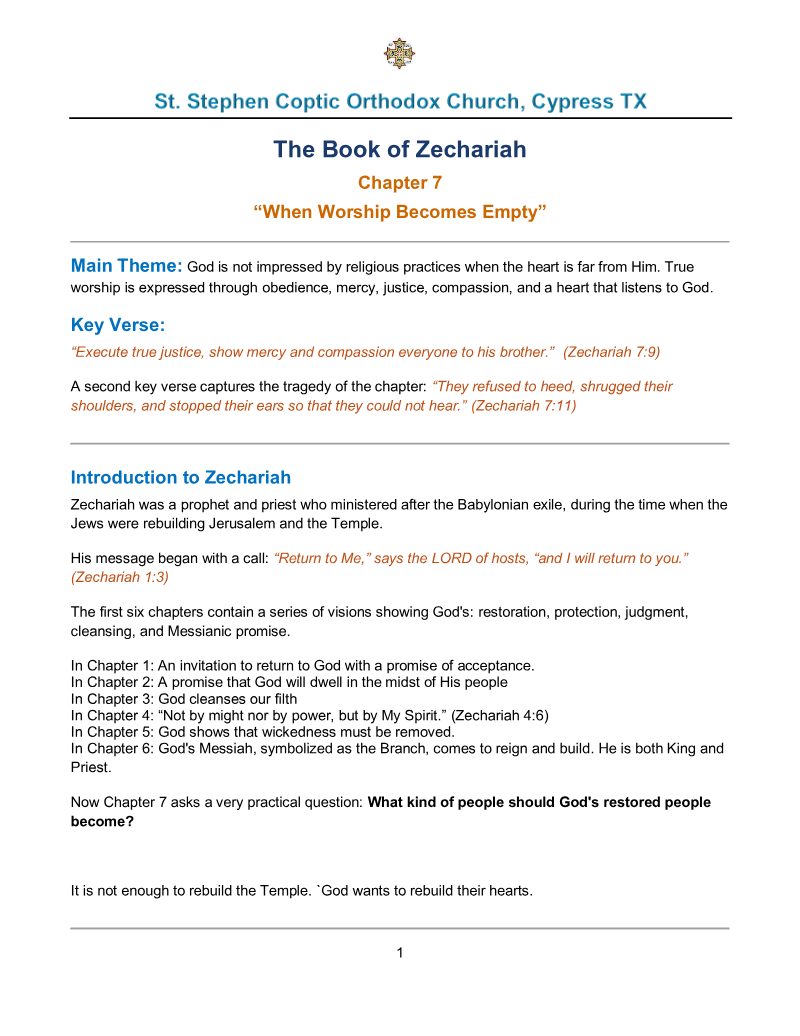
Zechariah 7
When Worship Becomes Empty
Part 9 · Previous
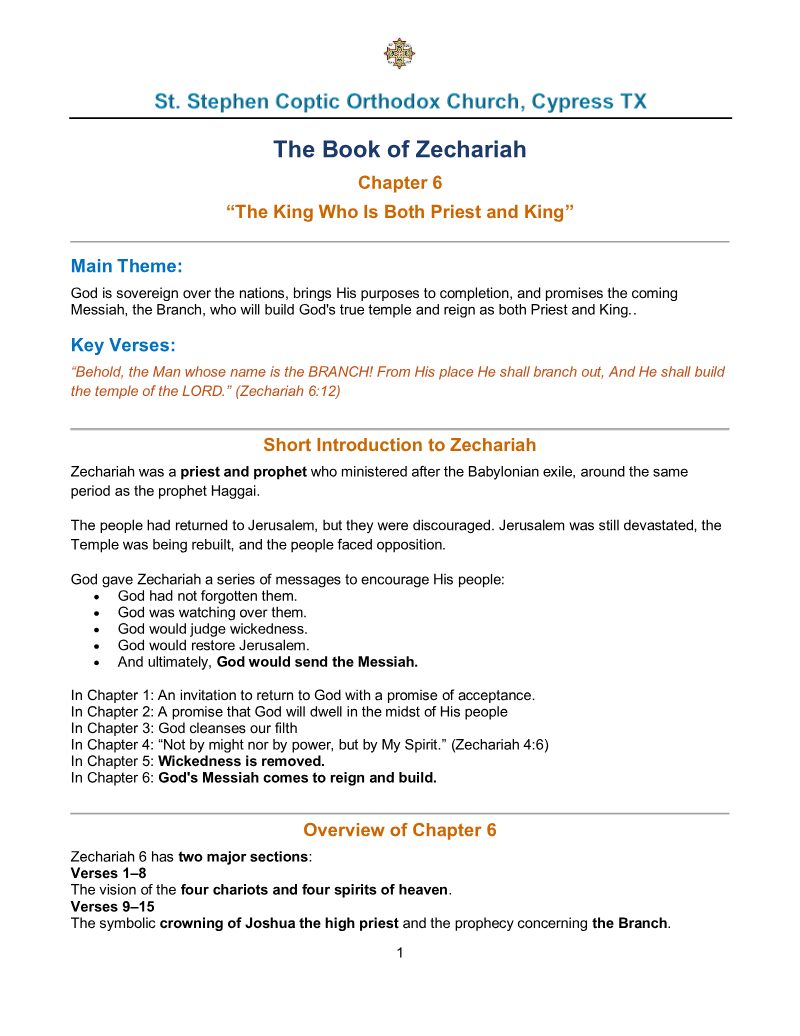
Zechariah 6
The King Who Is Both Priest and King
Part 8
The Minor Prophets series
13 studies so far, newest first. The next part appears here after the next English Bible Study.
See the whole series