
Minor Prophets · Part 11
Zechariah 9
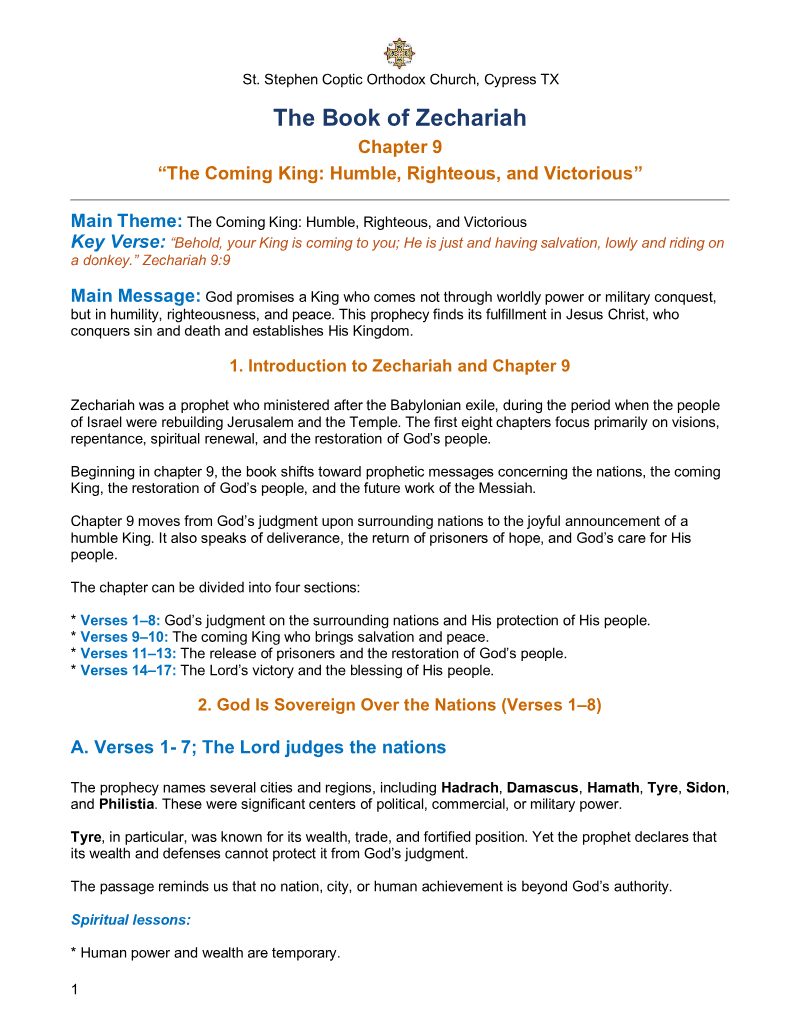
The Coming King: Humble, Righteous, and Victorious
God promises a King who comes not through worldly power or military conquest, but in humility, righteousness, and peace. This prophecy finds its fulfillment in Jesus Christ, who conquers sin and death and establishes His Kingdom.
- Date
- Series
- Minor Prophets
Key verse
“Behold, your King is coming to you; He is just and having salvation, lowly and riding on a donkey.”
On this page
Outline
1. Introduction to Zechariah and Chapter 9
Zechariah was a prophet who ministered after the Babylonian exile, during the period when the people of Israel were rebuilding Jerusalem and the Temple. The first eight chapters focus primarily on visions, repentance, spiritual renewal, and the restoration of God’s people.
Beginning in chapter 9, the book shifts toward prophetic messages concerning the nations, the coming King, the restoration of God’s people, and the future work of the Messiah.
Chapter 9 moves from God’s judgment upon surrounding nations to the joyful announcement of a humble King. It also speaks of deliverance, the return of prisoners of hope, and God’s care for His people.
The chapter can be divided into four sections:
- Verses 1–8: God’s judgment on the surrounding nations and His protection of His people.
- Verses 9–10: The coming King who brings salvation and peace.
- Verses 11–13: The release of prisoners and the restoration of God’s people.
- Verses 14–17: The Lord’s victory and the blessing of His people.
2. God Is Sovereign Over the Nations (Verses 1–8)
A. Verses 1- 7; The Lord judges the nations
The prophecy names several cities and regions, including Hadrach, Damascus, Hamath, Tyre, Sidon, and Philistia. These were significant centers of political, commercial, or military power.
Tyre, in particular, was known for its wealth, trade, and fortified position. Yet the prophet declares that its wealth and defenses cannot protect it from God’s judgment.
The passage reminds us that no nation, city, or human achievement is beyond God’s authority.
Spiritual lessons:
- Human power and wealth are temporary.
- Pride can lead individuals and nations away from God.
- God’s justice extends beyond Israel to all peoples.
- Security based solely on possessions, influence, or achievements is fragile.
B. Verse 8; God protects His house
God promises to guard His house and prevent the oppressor from passing through it again.
This was a message of hope to a people who had experienced invasion, exile, and destruction. God was assuring them that He had not abandoned them.
The promise of protection does not mean that God’s people will never face hardship. Rather, it assures them that God remains present and faithful, even when circumstances seem uncertain.
Christ in this passage
Christ is the true refuge and protector of His people. In John 10:28–29, He speaks of giving His sheep eternal life and keeping them in His hand.
The Church’s security does not rest primarily on worldly strength, resources, or influence, but on the faithfulness of Christ.
Patristic reflection
St. Cyril of Alexandria frequently emphasizes in his biblical interpretation that God’s providence extends over all creation and that the prophetic Scriptures should be understood in the light of Christ’s saving work. This passage can therefore remind us that the Lord who governs the nations also gathers and protects His people through Christ.
Practical applications
- When facing uncertainty: Remember that God is not limited by political, economic, or social circumstances.
- When experiencing success: Avoid the pride of Tyre, which trusted in wealth and defenses.
- In church service: Build the ministry on prayer, faithfulness, and Christ rather than on human recognition or resources.
- In family life: Teach children that true security comes from living in relationship with God, not merely from financial stability or personal achievement.
Reflect
What are some “fortified walls” in our lives that we trust more than God?
3. The Coming King: Humble, Righteous, and Victorious (Verses 9–10)
A. Verse 9; “Behold, your King is coming to you”
This is one of the clearest Messianic prophecies in the Old Testament. The prophet announces the arrival of a King who is:
- Righteous: He is just in His nature and actions.
- Having salvation: He comes to save His people.
- Lowly: He does not come in arrogance or worldly grandeur.
- Riding on a donkey: His entrance is marked by humility and peace.
The prophecy was fulfilled when Jesus entered Jerusalem riding on a donkey. (Read Matthew 21:1–11 and John 12:12–16.)
The Gospel writers explicitly connect Jesus’ triumphal entry with Zechariah’s prophecy. Christ did not enter Jerusalem on a warhorse, surrounded by an army. He entered humbly, revealing the character of His Kingdom.
The crowd welcomed Him with cries of “Hosanna,” but many misunderstood the nature of His kingship. Some expected a political liberator who would overthrow Roman rule. Jesus came to deliver humanity from a deeper bondage: sin, death, and separation from God.
B. The King’s humility
The donkey symbolizes the peaceful nature of the King’s coming. Christ’s humility was not weakness or an inability to exercise power. It was a voluntary expression of divine love. (Read Philippians 2:5–8).
St. Paul describes Christ, who humbled Himself and became obedient to the point of death, even the death of the cross.
Christ’s humility teaches us that true greatness is revealed through love, obedience, and self-giving.
Patristic reflection
St. John Chrysostom, in his reflections on Christ’s triumphal entry, draws attention to the contrast between Christ’s humble manner and the worldly expectations of kingship. Christ’s actions reveal that His Kingdom is not established through earthly display, but through divine authority and humility.
St. Cyril of Alexandria also emphasizes that the Lord’s entry into Jerusalem reveals the nature of His saving mission: the King comes gently to reconcile humanity to God.
C. Verse 10; “He shall speak peace to the nations”
The prophecy continues by describing a King whose dominion extends from sea to sea and to the ends of the earth.
Christ’s Kingdom is not restricted to one nation or geographic territory. His salvation is offered to all people. (Read Ephesians 2:14–17).
Christ is our peace. Through His Cross, He reconciles humanity to God and breaks down the barriers that divide people.
The peace Christ brings is more than the absence of conflict. It is reconciliation with God, the healing of the human heart, and the restoration of relationships through grace.
D. The difference between worldly power and Christ’s Kingdom
| Worldly kingdoms | Christ’s Kingdom |
|---|---|
| Often seek power through force | Triumphs through sacrificial love |
| Depend on wealth and armies | Depends on divine authority |
| May promote pride and status | Calls for humility and service |
| Are temporary | Is everlasting |
| Seek outward submission | Transforms the heart |
Practical applications
- In leadership: Lead through service, not control. A Christian leader should reflect the humility of Christ.
- In disagreements: Seek reconciliation rather than victory over another person.
- In success: Let Christ’s humility shape how you use your gifts and influence.
- In spiritual life: Welcome Christ not only as a Savior who comforts us, but as King who has authority over our decisions.
- During Holy Week: When we remember Christ’s entry into Jerusalem, ask whether we welcome Him as Lord even when His will challenges our expectations.
Reflect
Do I want Christ to be King over my life, or do I sometimes want Him only to fulfill my plans?
4. The Blood of the Covenant and the Prisoners of Hope (Verses 11–13)
A. Verse 11; “Because of the blood of your covenant”
God promises to release prisoners from a waterless pit because of the blood of the covenant.
In its historical setting, this image would have brought hope to people who remembered exile and oppression. The imagery of prisoners being released points toward restoration and deliverance.
For Christians, the blood of the covenant finds its fullest meaning in the saving blood of Jesus Christ. (Read Matthew 26:27–28 and Hebrews 9:11–14).
At the Last Supper, Christ speaks of His blood as the blood of the new covenant, shed for the forgiveness of sins. His sacrifice opens the way for humanity to be reconciled with God.
The waterless pit can also serve as a spiritual image of bondage: sin, despair, guilt, resentment, and spiritual emptiness. Christ comes to set captives free.
B. Verse 12; “Return to the stronghold, you prisoners of hope”
This is one of the most encouraging expressions in the chapter.
The people are called prisoners of hope. They have experienced hardship, but they are not without a future. God calls them to return to the stronghold, where He promises restoration.
Christian hope is not wishful thinking or denial of suffering. It is confidence in God’s faithfulness, even when circumstances have not yet changed. (Read Romans 5:3–5).
St. Paul teaches that tribulation can produce perseverance, character, and hope. Christian hope is rooted in God’s love poured into our hearts through the Holy Spirit.
C. Verse 12 - 13; God restores His people
God promises to restore His people and strengthen them. The language of bow, sword, and battle reflects the historical setting of conflict and deliverance.
For Christians, this can also remind us of the spiritual struggle against sin and the need to stand firm in faith. (Read Ephesians 6:10–17).
Our struggle is not against flesh and blood. God equips His people with spiritual armor, including truth, righteousness, faith, salvation, and the Word of God.
Patristic reflection
St. Athanasius, in On the Incarnation, explains that through Christ’s death and resurrection, the power of death is broken and humanity is offered life. This provides a strong Christian lens for reading the promise of liberation in Zechariah 9:11–12: Christ frees us from the deepest captivity and calls us into the hope of new life.
Practical applications
- For those burdened by guilt: Christ’s blood offers forgiveness and the possibility of a new beginning.
- For those discouraged: Do not confuse a difficult season with the absence of God.
- For those struggling with sin: Return to Christ, the stronghold, through repentance, confession, prayer, and the life of the Church.
- For those serving others: Become a messenger of hope to people who feel trapped by loneliness, failure, or grief.
Reflect
What is one area of my life in which I need to become a “prisoner of hope” rather than a prisoner of fear?
5. The Lord’s Victory and the Beauty of His People (Verses 14–17)
A. Verses 14 – 15; The Lord appears over His people
The prophet describes the Lord appearing over His people, going forth like a warrior to defend them.
The language is vivid and powerful. God is not distant or indifferent to the struggles of His people. He is actively involved in their deliverance.
In the New Testament, Christ’s victory is revealed most fully through His Cross and Resurrection. (Read 1 Corinthians 15:54–57).
Christ conquers death, and through Him believers receive the promise of victory over sin and death.
The victory of Christ does not mean Christians will never experience suffering. It means that suffering and death do not have the final word.
B. Verse 16; The Lord will save His people
The Lord will save His people as the flock of His pasture. The image of a shepherd highlights God’s personal care and covenant love.
Christ identifies Himself as the Good Shepherd who lays down His life for the sheep. (Read John 10:11–16).
The Good Shepherd knows His sheep, protects them, and gathers them into one flock. The Lord’s victory is therefore not simply a display of power; it is the victory of divine love that saves and gathers His people.
C. Verse 17; “How great is its goodness”
The chapter concludes with an image of abundance, beauty, and blessing. The grain and new wine symbolize God’s provision and the flourishing of His people.
The greatest blessing God offers is not material prosperity alone, but life in communion with Him. (Read John 10:10).
Christ came that His people may have life abundantly. This abundant life is found in knowing God, growing in holiness, loving others, and sharing in the life of Christ.
Patristic reflection
St. Augustine often contrasts earthly peace and prosperity with the lasting peace found in God. His teaching helps us recognize that the blessings of Zechariah’s final verses point beyond material abundance toward the deeper joy of communion with the Lord.
Practical applications
- Trust God in spiritual battles: Victory may come through perseverance and faithfulness rather than immediate relief.
- Live as part of Christ’s flock: Stay connected to the Church and support others in their spiritual journey.
- Recognize God’s blessings: Practice gratitude for spiritual gifts, relationships, daily provision, and the hope of eternal life.
- Become a blessing: Reflect the Good Shepherd by caring for those who are weak, forgotten, or struggling.
Reflect
How can my life show that I belong to Christ, the Good Shepherd?
6. Christ in Zechariah 9
| Zechariah 9 | Fulfillment and meaning in Christ |
|---|---|
| Verse 9: The righteous and humble King | Jesus enters Jerusalem in humility (Matthew 21:1–11). |
| Verse 9: The King brings salvation | Christ saves humanity from sin and death (Luke 19:10). |
| Verse 10: Peace to the nations | Christ reconciles humanity to God (Ephesians 2:14–17). |
| Verse 11: The blood of the covenant | Christ establishes the new covenant through His blood (Matthew 26:28). |
| Verse 12: Prisoners of hope | Christ frees those held captive by sin and death (John 8:36). |
| Verses 14–16: The Lord’s victory and care | Christ conquers death and shepherds His people (1 Corinthians 15:54–57; John 10:11). |
| Verse 17: Goodness and beauty | Christ gives abundant life and the hope of eternal communion with God (John 10:10). |
Zechariah 9 presents a unified picture of the Messiah: the humble King, the Prince of Peace, the Redeemer who sheds His blood, the Deliverer who frees captives, and the Good Shepherd who saves His flock.
7. Personal Reflection
- Why do you think God chose to reveal the Messiah as a humble King riding on a donkey rather than as a powerful military ruler?
- What is the difference between welcoming Jesus as Savior and submitting to Him as King?
- What are some forms of spiritual captivity that people experience today?
- How can we become “prisoners of hope” during periods of suffering or uncertainty?
- In what ways can our church reflect Christ’s Kingdom of humility, peace, and service?
8. Summary and Main Takeaways
- God is sovereign over all nations, powers, and human achievements.
- The Messiah comes as a humble and righteous King, not according to worldly expectations.
- Jesus fulfills the prophecy of the King entering Jerusalem on a donkey.
- Through the blood of the new covenant, Christ offers forgiveness and liberation from sin.
- Christians are called to live as prisoners of hope, trusting God through suffering.
- Christ is the victorious Good Shepherd who gathers, protects, and gives life to His people.
One sentence to remember
The King who came humbly to Jerusalem is the victorious Savior who frees us from captivity, gives us peace, and leads us into abundant life.
Closing Prayer
O Lord Jesus Christ, our righteous and humble King, we thank You because You came to us in love and humility to bring us salvation and peace. Free us from the bondage of sin, fear, pride, and despair. Make us prisoners of hope, trusting in Your promises even in times of difficulty. Reign in our hearts, our families, and our church. Teach us to follow Your humility, to seek peace with others, and to serve with love. May we remain under Your care as the Good Shepherd and rejoice in the abundant life You have promised. Through the intercessions of the Holy Theotokos St. Mary and all Your saints, hear us as we pray. Amen.
8 pages in the handout
Minor Prophets
More in this series
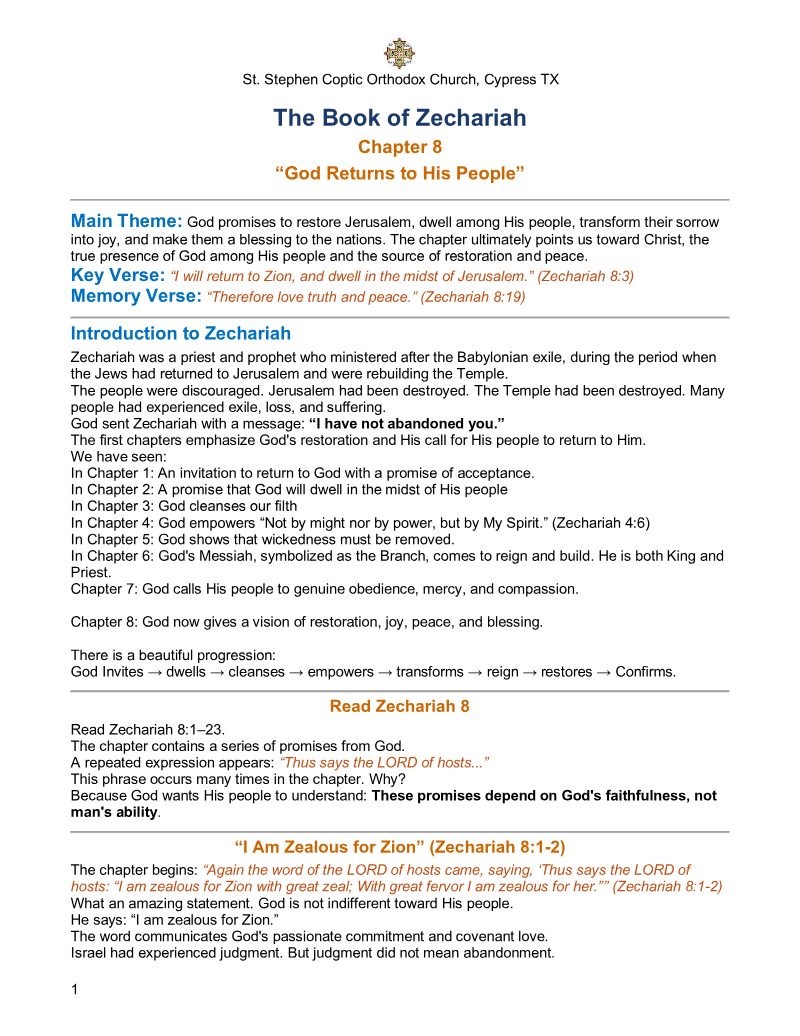
Zechariah 8
God Returns to His People
Part 10 · Previous
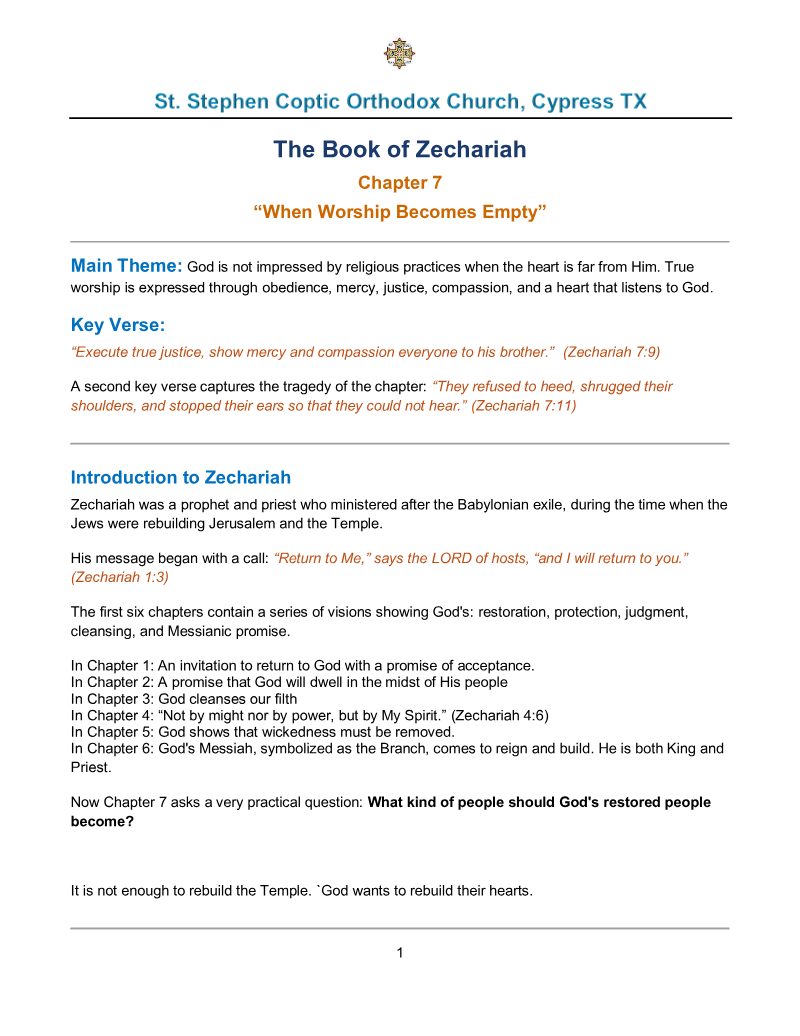
Zechariah 7
When Worship Becomes Empty
Part 9
The Minor Prophets series
13 studies so far, newest first. The next part appears here after the next English Bible Study.
See the whole series